
Second home HVAC freeze protection NJ shore: winterize a vacant home in the right order
Second home HVAC freeze protection NJ shore is a sequence, not one setting. Keep heat on at a low hold, prove the heat runs before you close, add a freeze alert with a cellular backup, and shut the water main off. Skipping the proof-test is what turns a furnace failure into a February flood.

Second home HVAC freeze protection NJ shore is a sequence, not one setting. Keep heat on at a low hold, prove the heat runs before you close, add a freeze alert with a cellular backup, and shut the water main off. Skipping the proof-test is what turns a furnace failure into a February flood.
The order matters more than any single device
Most winterization advice reads like a shopping list: buy a smart thermostat, buy a freeze alarm, shut the water off. The list is not wrong, but the list hides the fact that these steps only work in sequence. A smart thermostat that cannot reach the furnace because the furnace failed in November is a paperweight. A water shutoff that protects the domestic plumbing does nothing for the boiler loop. A freeze alarm with perfect cellular signal can tell you the temperature is dropping, but it cannot heat the house.
For a vacant shore house, the sequence is:
- Hold heat. The heating system has to keep the coldest pipe above freezing.
- Prove heat. The system has to be fired and checked in heating mode before the house closes, not in June.
- Monitor heat. A remote alert has to reach you when the heat stops, including when Wi-Fi goes down.
- Limit water. The main has to be off so a burst pipe cannot run for days.
Each layer only earns its place if the layer before it works. That is the whole design logic, and it is what separates a winterization plan from a list of gadgets.
The failure chain: how a vacant shore house floods
A vacant house fails differently from a year-round home. Nobody hears the furnace stop at 2 a.m. in January. Nobody notices the condensate pump quit. Nobody sees the thermostat reading drop from 55°F to 45°F to 30°F. By the time anyone opens the door, water may have been running for days.
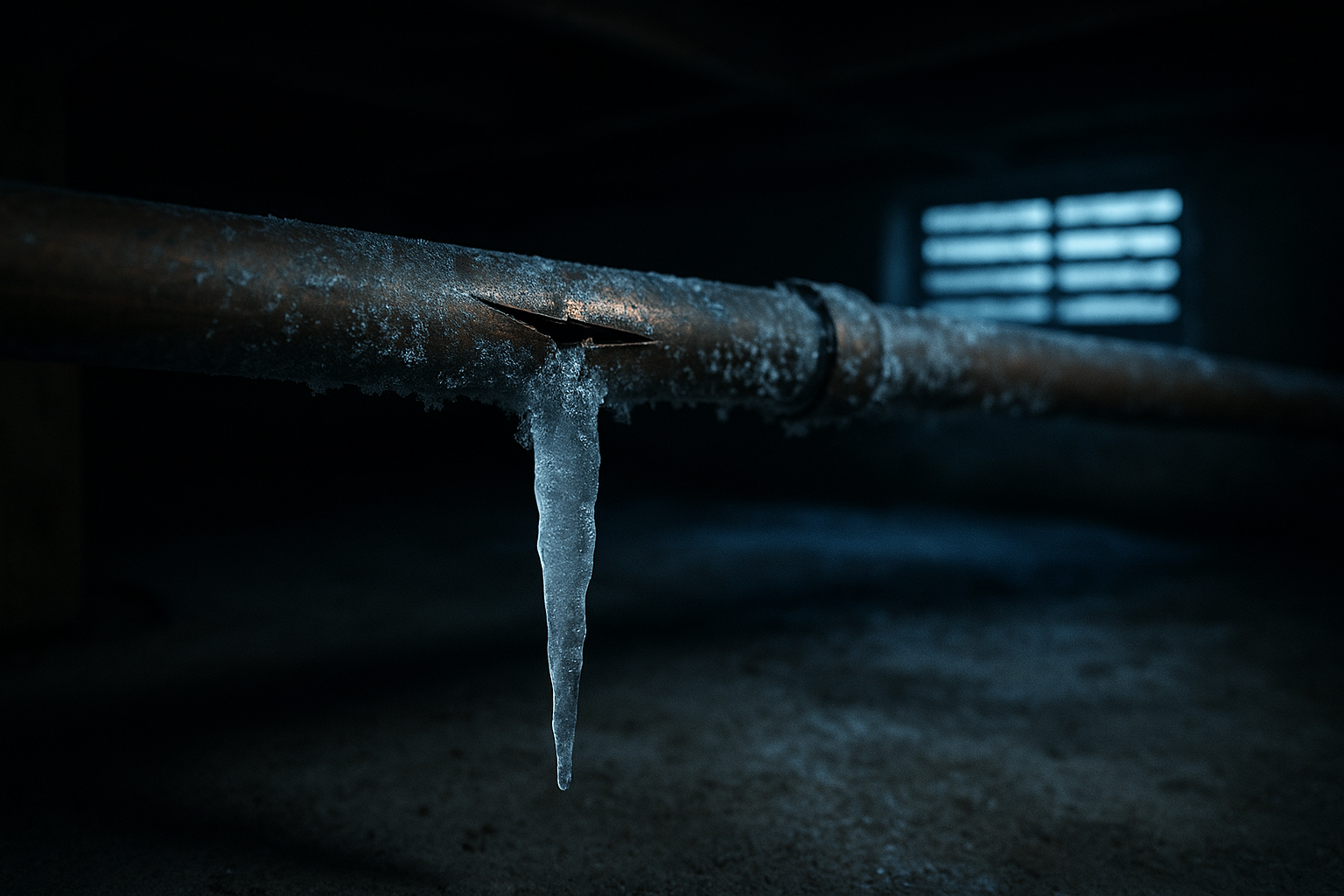
The chain is predictable:
- The thermostat calls for heat.
- The furnace fails to fire because of a corroded part or a lost ignition.
- Interior temperature slides past the low hold.
- The coldest pipe in the house — usually in an exterior wall, a crawlspace, or a closed-off addition — drops below 32°F (0°C) and freezes.
- The pipe bursts.
- If the water main is still open, supply water runs through the split until someone finds it.
The reference point is plumbing, not comfort. A furnace in a seasonal shore house is winter freeze protection for the pipes as much as it is heating equipment. A silent failure in February can mean burst pipes, flooded floors, and a five-figure insurance claim — discovered weeks later.
There is a second failure pattern specific to the shore. A Margate house occupied twelve weeks a year puts very few run hours on its equipment, and owners sometimes assume that means the system will last forever. It does not work that way. Compressors and blower motors age by run time, but coils, cabinets, contactors, wiring, and fittings age by the calendar, because salt-air corrosion happens whether the thermostat is calling or not. A lightly used shore system can be mechanically young and environmentally old at once. It seems fine in June and quits during the first hard cold snap.
That is why the winterization sequence cannot start in November with a thermostat setting. It has to start with a test that proves the heat actually runs.
Step 1: Keep heat on at a low hold
There is no single universal winter setpoint for every shore house, and any guide that names one number is guessing about your building. The correct question is not "what temperature should I set?" but "what hold keeps the coldest pipe in this house above freezing?"
Water freezes at 32°F (0°C). The thermostat reads the air near itself, not the air in the crawlspace, the uninsulated addition, or the wall cavity where the kitchen pipe runs. A house with a warm core and a cold rear bump-out needs more margin than a tight, compact house. The setpoint must protect the coldest point, not just the hallway.
The right approach is to have an HVAC contractor set the low-temperature hold based on the actual house: thermostat location, insulation, exposure, and the location of the plumbing. Then the contractor has to test that the heating system runs and that warm air reaches the rooms most likely to freeze.
Do not turn the heat off. Do not trust a "vacation" mode that only runs a few minutes a day unless you have verified what happens in the cold corners. A low-temperature hold is a deliberate setting, not an afterthought.
Step 2: Prove the heat runs before you close
This is the step most owners skip, and it is the one that matters most. A system that cooled the house in August proves nothing about January. Heating mode uses different components — the burner or heat strips, the flame sensor, the inducer, the heat exchanger, the reversing valve on a heat pump — and those components have been sitting unused since the previous spring.
A fall proof-test is not a filter change. It is a firing test:
- The system has to start from the thermostat call and run in heating mode.
- The burner or heat strips have to stay lit or energized through a full cycle.
- Airflow has to reach every room, including the ones with plumbing on exterior walls.
- The condensate path has to drain.
- On a boiler, the low-water cutoff and circulator have to operate.
- On a heat pump, the thermostat has to be configured for heat-pump operation so auxiliary heat stages run when the outdoor unit cannot keep up.
The failure that matters is the quiet one: the furnace starts, runs briefly, and then locks out. If that happens while the house is occupied, someone notices. If it happens after closing, nobody does until the pipes freeze.
If the furnace is old enough that you cross your fingers each fall, the proof-test is also the moment to decide about furnace replacement. The furnace in a seasonal home is winter freeze protection for the plumbing, and the cost of a replacement is cheap compared with a silent failure in February. Pair the furnace with a smart thermostat that alerts your phone when indoor temperatures drop, and you have a remote early-warning system for a few hundred dollars.
Step 3: Know your fuel and furnace before you leave
The heating fuel changes the failure mode of a vacant shore house, and each fuel has a different off-season risk.
An oil furnace depends on fuel delivery. If the tank runs low over the winter, the burner stops, the house goes cold, and nothing tells you until the freeze alarm — if you installed one — fires. A propane furnace has the same dependency with a different tank: propane runs out the same way oil does, and an out-of-state owner may not notice the level until the house is cold.
Natural gas has no delivery tank, but it still depends on the furnace firing. The gas supply does not fail the way a delivered fuel can, but the ignition, the flame sensor, and the controls can. The fuel is only the beginning of the reliability question, not the end of it.
The point is not that one fuel is always safer. The point is that each fuel has a specific failure mode, and the pre-closing service has to address the one you actually have. Have your HVAC contractor confirm the tank level, the burner, and the controls for the fuel your house uses before you close.
Step 4: Monitor the heat, and do not trust Wi-Fi alone
A professionally installed smart thermostat is the center of the monitoring stack because it connects the heating system to your phone. For a vacant shore house, the feature that matters is not scheduling or energy reports. It is the low-temperature alert: the thermostat watches indoor temperature and pushes a notification the moment the house drifts below your threshold.
That converts a silent risk into an actionable alert. Instead of discovering a no-heat problem when you open the door in April, you get a notification while the problem is still just a no-heat call, and you can call a local contractor for emergency service before the house drops below freezing.
Professional installation matters more here than in a year-round house. Older Atlantic County homes often lack the C-wire a smart thermostat needs, and the wiring has to be checked before anything is purchased. The thermostat also has to be configured for the actual system type: single-stage, multi-stage, heat pump, or boiler. A heat pump set up as a conventional furnace will not control auxiliary heat correctly, and that can matter on the coldest night of the year.
Installed models include Nest, Ecobee, and Honeywell Home. The right choice depends on the wiring, the system type, and how much remote detail the owner wants. A professional install should include Wi-Fi setup, app configuration, and hands-on training so the owner actually understands the alerts.
The efficiency benefit is secondary but real: Energy Star estimates typical savings around 8 percent of heating and cooling costs. For a seasonal house, the bigger value is the early warning.
The limitation is connectivity. If the modem or router loses power, or the internet provider has an outage, the thermostat may still control the heat locally, but it cannot tell you anything. The alert never leaves the house. That is exactly the failure mode a vacant shore house cannot afford, because the whole point of remote monitoring is to work when conditions are already going wrong.
A cellular freeze alarm works on a different path. It does not depend on the home's Wi-Fi, the router, or the local internet provider. It uses the cellular network directly, so it can still send a call or text when the house has lost power or the internet is down.
The practical answer for most out-of-state owners is both. Use a Wi-Fi smart thermostat for remote control and temperature history. Add a cellular freeze alarm as the life-safety layer that works when the Wi-Fi layer does not. Test both before closing, and confirm the cellular device has reliable signal from the exact spot where it will sit.
Do not assume a Wi-Fi-connected house is a monitored house. Connectivity is only as good as the weakest link between the sensor, the router, the internet, and your phone.
Step 5: Shut the water off and place leak sensors
Keeping the heat on protects the pipes from freezing, but it does not protect the house from every water failure. A fitting can fail, a supply line can crack, a water heater can leak, and a pipe can freeze in a cold corner the heat never reached. If the water is still on, any of those failures becomes a running-water event.
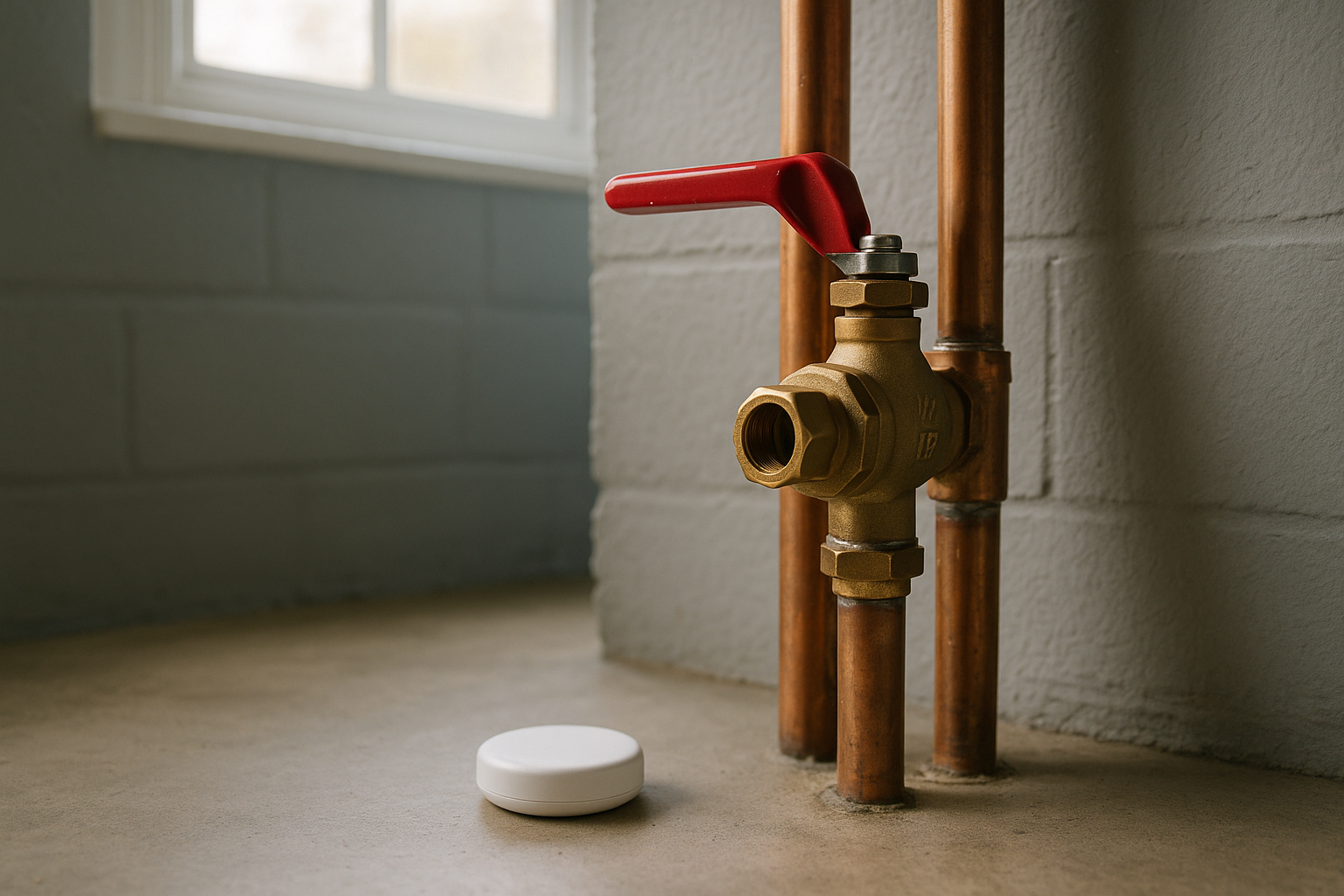
The cheapest catastrophic-loss reduction is to shut the water off at the main before you close the house. That removes the supply, so a failed pipe or fitting cannot keep flooding for days. The house can still have water damage from the water already in the pipes, but it cannot have the multi-day, whole-house flood that happens when the supply stays on.
Draining the domestic water lines is a separate step. Closing the main valve stops supply; opening faucets and drains lets water leave the pipes. The exact procedure depends on the plumbing layout, so it belongs in a fall service with a plumber or the HVAC contractor who handles the property.
Leak sensors add a detection layer for owners who keep water on for a caretaker, a rental, or a renovation. They are most useful where water first appears: under sinks, behind the washing machine, near the water heater, and in the mechanical room. A sensor in the basement does not help if the leak is on the third floor.
Water shutoff is not a substitute for heat. It is the backstop for the day the heat fails and the alert arrives too late.
Step 6: Protect the hydronic loop separately
A hydronic heating system contains water that is separate from the domestic plumbing. Draining the house's domestic water does not drain the boiler loops. If those loops freeze, the damage can be just as expensive, and the repair is more specialized.
Glycol is the standard answer for hydronic freeze protection. Mixed with the system water, it lowers the freeze point below what the loop would otherwise tolerate. The concentration is not a guess; it is matched to the lowest expected temperature for the location and the system's design. Too little glycol leaves the loop vulnerable. Too much reduces heat transfer and causes its own operating problems. The mixture has to be tested and adjusted, not just topped off.
Low-water cutoff is a boiler safety control, not a freeze protection device by itself, but it belongs in the conversation because a boiler that fires without enough water can destroy itself during the same cold-weather conditions that stress everything else.
Circulation is the other layer. Moving water resists freezing better than still water, and a circulator controlled by a freeze sensor can keep water moving through vulnerable loops during a cold snap. The limitation is obvious: a circulator only helps while it has power. If the circulator fails or the power goes out, circulation stops.
The hydronic decision should be made with a boiler technician who can test the glycol concentration, confirm the low-water cutoff operates, and verify that the freeze control actually starts the circulator. None of these are settings an owner should assume are correct from the previous season.
For out-of-state owners and property managers
A seasonal shore house is often an hour or more from its owner, and the winterization plan has to work from that distance. That means the plan cannot depend on the owner being present to notice a problem.
The plan has to be written, not remembered. It has to name a local contact — a property manager, a neighbor, or a contractor — who can reach the house when the owner cannot. It has to use a contractor with 24/7 emergency response, because a freeze alert at 2 a.m. is only useful if someone can act on it before the pipes freeze. And the alerts have to go to the right phone, not the phone of whoever set up the thermostat last year.
Property managers need the same documented sequence for every property they handle. The risk is not that a manager ignores a property; it is that a step gets dropped when a tenant leaves, a caretaker changes, or a house changes hands. A one-page checklist with the low hold, the alarm thresholds, the water shutoff location, and the emergency number removes that ambiguity.
The coastal corrosion factor: why shore furnaces fail in winter
Shore equipment fails on a different clock than inland equipment. Inland, run time drives wear. At the shore, the calendar does. Salt air corrodes coils, cabinets, contactors, wiring, and fittings whether the thermostat is calling or not, so a system that ran only a few weeks all year can still enter January with a corroded flame sensor, a pitted contactor, or a pressure switch that no longer closes.
That is why the proof-test in Step 2 is not optional at the shore. It is the only way to catch the calendar failures before the house is closed. A system that cooled fine in August can refuse to fire in December, not because it wore out, but because something corroded while it was sitting.
Coastal-rated equipment is specified for this. Coastal-rated AC and heat pump systems are built to resist salt-air corrosion, and for a seasonal shore house that is a reliability decision as much as a longevity decision. The alternative is standard equipment that looks fine in the listing photos and fails three years later at the worst possible moment.
The winter failure list at the shore is short and consistent: ignition, flame sensing, inducer, pressure switch, contactor, and condensate handling. All of them can be checked in a fall service. None of them should be discovered in February.
Winterization checklist for a vacant shore home
Use this checklist before you close. The sequence moves from heat to proof to monitoring to water.
- Service the heating system before closing, including a full firing test in heating mode.
- Set the thermostat to a low-temperature hold, never to off.
- Have the low hold set for the coldest pipe in the house, not just the hallway.
- Confirm the smart thermostat is wired, configured, and sending alerts to the right phone.
- Test the Wi-Fi connection and the cellular backup path from the property.
- Place freeze alarm sensors in the coldest rooms and the crawlspace.
- Shut off the main water supply and drain the domestic lines according to the plumbing layout.
- Place leak sensors at sinks, the water heater, and the laundry area.
- Have hydronic glycol tested and adjusted, and confirm the low-water cutoff and circulator operate.
- Record the local contractor's emergency number and confirm 24/7 response is available.
- Check the property after the first hard cold snap, or have a local contact do it.
What freeze protection costs
The honest answer is that shore house freeze protection is a set of line items, not a single package price. The equipment category, the age of the house, the wiring, and the number of sensors all change the total.
One figure is well established: a professionally installed smart thermostat with freeze alerts is a few hundred dollars. That is the control-and-alert layer, and it is the cheapest way to turn a silent failure into a same-day emergency call.
For the other layers, ask for line-item quotes rather than a single lump sum. That makes it easier to compare proposals and see what is actually included.
| Cost category | What to ask for | What makes the price move |
|---|---|---|
| Smart thermostat installation | Installed price including C-wire run, configuration, and app training | Existing wiring, system type, number of stages |
| Cellular freeze alarm | Equipment price and any monthly cellular plan | Sensor count, signal quality, monitoring features |
| Leak sensors and water shutoff work | Per-sensor price and installation labor | Number of sensors, access to plumbing, main valve location |
| Hydronic glycol service | Test, flush, and fill price | System volume, glycol concentration, accessibility |
| Furnace replacement before closing | Written estimate covering equipment and permit scope | System size, fuel type, duct condition |
Monthly monitoring follows the same split. A Wi-Fi smart thermostat that sends alerts through your existing internet connection may have no separate monthly fee. A cellular-connected monitor may carry a monthly charge because it uses a cellular plan. Confirm whether the monitoring fee is included in the equipment quote, what happens if you cancel, and whether the alert still works during a power outage.
Do not let a quote become a guess. A contractor who has seen the property can give a firm number. A website that names a national average without seeing the house is not protecting anything.
Common mistakes that turn a cold snap into a claim
Five mistakes cause most of the winter damage in vacant shore houses.
- Turning the heat off. Mistake: assuming an empty house does not need heat. Fix: keep a low-temperature hold high enough to protect the coldest pipe.
- Testing the system in June. Mistake: learning the furnace will not fire when the house is already cold. Fix: run a full heating proof-test before you close in the fall.
- Relying only on Wi-Fi. Mistake: trusting a smart thermostat alert when the internet is the first thing to fail in a storm. Fix: add a cellular freeze alarm as the backup path.
- Leaving the water on. Mistake: heating the house but leaving the supply connected, so a burst fitting floods for days. Fix: shut the main and drain the lines before closing.
- Ignoring the hydronic loops. Mistake: draining the domestic water and assuming the boiler is protected. Fix: test glycol concentration and confirm the circulator and low-water cutoff work.
Frequently asked questions about second home HVAC freeze protection NJ shore
What temperature should I leave a vacant NJ shore house in winter?
There is no single correct setpoint because shore houses vary in insulation, exposure, and plumbing location. The goal is to keep the coldest pipe in the house above 32°F (0°C) with a margin. Have an HVAC contractor set the low hold based on the actual house, and never turn the heat off entirely.
Do I need Wi-Fi for freeze monitoring?
Wi-Fi works for a smart thermostat, but it should not be the only monitoring path. A Wi-Fi device stops sending alerts if the router or internet fails. A cellular freeze alarm uses the cellular network directly and can still reach you when the house has lost power or internet. Pair the two for a vacant property.
Should I shut the water off if I leave the heat on?
Yes, in most cases. Heat protects the pipes from freezing, but it does not stop a failed fitting or a freeze in an unheated corner from flooding the house. Shutting the main and draining the domestic lines limits how much water can escape if something fails while the house is empty.
Can a heat pump protect a vacant shore house?
Yes, if it is a cold-climate model and configured correctly. The thermostat must be set up as a heat pump so auxiliary heat stages run when needed. The system should be tested in heating mode before closing. A heat pump with a wrong thermostat configuration can leave the house colder than expected on the coldest night.
Does glycol protect the whole house or only the heating system?
Glycol protects the water inside hydronic heating loops. It does not protect domestic water pipes, drains, or fixtures. Those still need heat or draining. A shore house with a boiler needs both a domestic winterization plan and a hydronic freeze-protection plan.
How much does shore house freeze protection cost?
A professionally installed smart thermostat with freeze alerts is a few hundred dollars. Other layers, including cellular alarms, leak sensors, water shutoff work, and glycol service, vary by the property. Ask for line-item quotes and confirm monthly monitoring fees before you close.