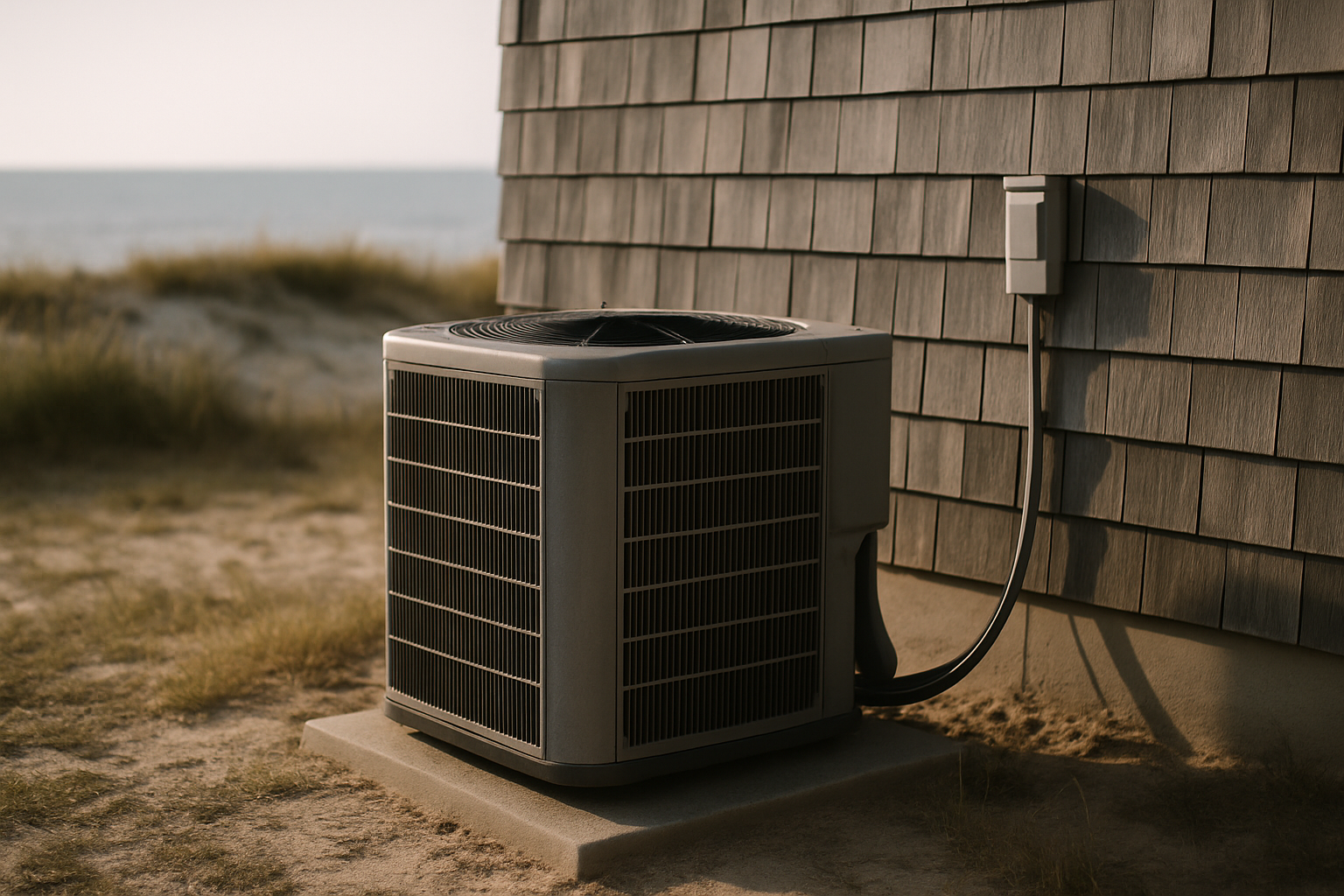
HVAC storm hardening at the NJ shore: wind anchoring, elevation, and post-storm restart
Shore HVAC storm hardening means anchoring the outdoor condenser against wind lift and overturning, raising it above the governing flood elevation where required, and following a strict electrical and refrigerant restart sequence after the storm passes. The anchoring method (tie-down straps, bolted stands, or an elevated platform) must match the unit, the site exposure, and the permit-approved detail.
Shore HVAC storm hardening means anchoring the outdoor condenser against wind lift and overturning, raising it above the governing flood elevation where required, and following a strict electrical and refrigerant restart sequence after the storm passes. The anchoring method (tie-down straps, bolted stands, or an elevated platform) must match the unit, the site exposure, and the permit-approved detail.
This guide covers the structural side of shore HVAC, not the corrosion side. Salt-air protection for coils and cabinets matters, but it is a separate decision from wind anchorage and flood elevation. A condenser can be corrosion-protected and still blow off its pad in a nor'easter, and a condenser bolted down at grade can still take on surge water. The two problems need two different fixes, and a restart after a storm needs its own order of operations.
The recommendations below apply to residential systems in Atlantic County, from the barrier islands of Brigantine, Atlantic City, Ventnor, Margate, and Longport to mainland towns such as Egg Harbor Township, Galloway, Northfield, Linwood, and Somers Point. Nothing here replaces the site-specific detail on your permit; it explains the decisions behind that detail so you can ask the right questions before the next storm.
Wind load basics: why condensers lift at the shore
A residential condenser is not as heavy as it looks. It sits on a pad, a small slab, or a stand, and in many installations nothing but its own weight keeps it in place. That is enough for normal weather. It is not always enough when a coastal storm puts sustained wind against a large, flat cabinet face.
The physics is simple. Wind pressing on the side of the unit creates horizontal force. Air moving over and around the cabinet also creates differences in pressure that can lift the unit, especially when the wind gets underneath an edge or a corner. Once one side starts to rise, the exposed area increases, and the unit can walk, tip, or overturn. A tipped condenser can kink the copper refrigerant lines, tear the low-voltage wiring, and pull the electrical connection out of the disconnect. At that point the failure is no longer about wind; it is about a sealed refrigerant circuit that has been opened and an electrical system that has been stressed.
At the NJ shore, the same weather system produces higher wind pressures than it does inland. Open water and low, flat barrier islands offer less surface friction to slow the wind down, so Brigantine, Atlantic City, Ventnor, Margate, and Longport see conditions that a sheltered mainland lot may never experience. Nor'easters can also sit offshore for hours, which matters because a unit that survives a short gust may not survive hours of sustained wind and salt spray.
Equipment anchorage for a coastal site is reviewed through the permit and inspection, which is why wind-rated HVAC anchorage is not one universal product. It is a set of straps, brackets, bolts, and fasteners selected to resist the design wind load at a specific location. A condenser in a courtyard in Linwood may need far less than the same condenser on an open lot in Longport. The approved detail, not a guess, decides which is which.
The same principles apply to roof-mounted and upper-level condensers, which are common on barrier-island homes that keep mechanical equipment out of the surge path. Height increases exposure, so a unit that would be stable at grade can become a problem on an upper deck or roof. The structural connection to the building has to carry both the wind load and the unit's own weight, and the building itself has to be able to accept the connection.
Anchoring methods compared
The right anchoring method follows three things: the flood elevation requirement for the lot, the wind exposure at the equipment location, and whether the install is new or a retrofit of an existing pad.
| Anchoring method | What it does | Best suited for | Key limitation |
|---|---|---|---|
| Hurricane tie-down straps | Metal straps across the unit base or cabinet, anchored into the pad or slab | Existing ground-level condensers on sound pads | Only as strong as the pad and the anchor pull-out resistance |
| Bolted brackets and stands | Brackets or bolts fix the unit to a pad or stand | New installs and replacements | The stand must also be anchored; a bolted unit on a loose stand still moves |
| Elevated platform | Raises the unit above the governing flood elevation | Flood-prone and barrier-island lots | Elevation increases wind exposure, so platform and unit must be engineered together |
| Upper-level or roof mounting | Keeps equipment above the surge path | Island homes where grade elevation is not enough | Highest wind exposure; requires structural review |
None of these is automatically better. A tie-down retrofit on a cracked pad is wasted work, and an elevated platform with the condenser simply set on top is a flood solution with a wind problem. The method has to match the site.
Hurricane tie-down straps and bolted anchorage
A hurricane tie-down for an AC condenser in NJ works the way it does on other equipment. Straps or brackets attach to the unit's base or cabinet and are anchored into the concrete pad or slab with mechanical anchors. The straps resist both lift and sliding, keeping the unit in place when the wind tries to pick it up or push it sideways.
For an existing condenser on a sound, level pad, tie-downs are usually the lowest-disruption retrofit. The pad itself is the foundation of the whole detail. It has to be uncracked and thick enough to hold the anchors, because the strap can only be as strong as what it is fastened to. If the pad is crumbling, spalling, or undersized, the correct order is to repair or replace the pad first, then anchor the unit to it.
At the shore, hardware selection matters as much as strength. Salt aerosol corrodes fasteners, and a strap that rusts through in a few seasons is no longer doing its job even if it looks intact from across the yard. Coastal anchoring details should use corrosion-resistant or coated hardware, and the fasteners should be checked during routine maintenance just like the coil is rinsed. The same salt air that ages a condenser cabinet also attacks the anchor hardware holding it down.
Bolted anchorage is the new-install version of the same idea. When a system is being replaced, the unit can be fixed through its mounting points to a pad, a stand, or a platform, and the anchor locations can be set before the equipment goes in. This is the easier way to get the detail right, because the pad can be poured to suit the anchorage instead of the anchorage being adapted to whatever pad already exists.
Elevated platforms for wind and flood
On lots where the governing flood elevation sits above grade, the condenser gets raised on an elevated platform. The platform may be a structural stand on posts or piles, or a raised slab. Its job is hydraulic: keep the equipment above the water level that can reach the site during the design flood.
Elevation creates a wind trade-off. A unit raised several feet off the ground catches more wind than the same unit at grade, and the taller the platform, the longer the lever arm the wind has to work against. That means an elevated installation needs two connections treated as one system: the platform anchored to its foundation, and the condenser anchored to the platform. If the platform is engineered for the flood but the condenser is simply set on top, the storm will find the weak link.
This is where wind-rated HVAC anchorage stops being optional. The approved detail should cover both connections, and the platform should be built so the unit cannot slide, lift, or tip. On barrier-island lots, where elevation and wind exposure arrive together, the platform is not just a stand for the equipment; it is part of the equipment's structural system.
Placement also affects how well the platform performs. The platform should be sited so the unit keeps its code-required clearances and its service access, and so storm debris is less likely to pile against the coil. A platform that solves the flood problem but blocks airflow or service access has traded one failure for another.
One practical note: elevated equipment is also easier to work on and harder to flood, but it is not automatically protected from salt. Elevation changes where the unit sits in the storm; it does not change what the salt air does to it over the years.
Flood elevation vs. corrosion: two separate decisions
One of the most common mistakes at the shore is treating flood elevation and salt-air corrosion as the same problem. They are not, and a homeowner who treats them as one usually pays for it twice.
Flood elevation is structural and hydraulic. It answers one question: how high must the equipment sit so that the design flood does not reach it? That height comes from the flood requirements applied to the lot and is confirmed through the permit and inspection. Flood elevation is a placement decision first: the equipment goes at grade, on a stand, or on a platform depending on where the water can reach.
Corrosion protection is material. It answers a different question: how do the coil, cabinet, electrical contacts, and fasteners survive years of salt aerosol even when there is no flood? That is where corrosion-resistant or coated coils and treated cabinets come in, along with corrosion-resistant hardware and periodic fresh-water coil rinses.
Both problems often apply at once on the barrier islands. A home in Brigantine, Atlantic City, Ventnor, Margate, or Longport may need elevated placement for flood and coastal-spec equipment for salt. A mainland home in Egg Harbor Township or Galloway may need little or no flood elevation but still benefit from corrosion-resistant hardware if it sits near the bay. The practical order is: settle the elevation from the flood requirement, choose the equipment and hardware for the salt environment, then anchor everything for the wind at that elevated position.
Salt spray does not respect the flood line. A condenser elevated well above the design flood still sits in the same salt aerosol as a unit at grade, because salt travels with the wind, not with standing water. That is why the elevation decision and the corrosion decision are made separately even when they are made on the same day by the same contractor.
Post-storm AC restart sequence: a safe order of operations
After a nor'easter or tropical storm, the temptation is to flip the breaker and see what happens. That sequence risks a short, a fire, or a compressor failure on top of whatever the storm already did. A post-storm AC restart at the NJ shore follows a specific order, and the first rule is the simplest: do not energize equipment that has been in water.
- Do not power up flooded or submerged equipment. If the condenser, disconnect, or wiring sat in water, or if standing water still surrounds the pad, keep the breaker off. Water and line voltage do not mix, and a wet compressor or contactor can short or energize the cabinet. This is a stop-and-call condition.
- Inspect the unit before touching it. Walk the perimeter. Confirm the condenser is still level and in place, the cabinet panels are intact, the disconnect box is closed, the refrigerant lines are not kinked or pulled, and no debris is jammed against the coil. Take photos of anything out of place before moving it; they help a contractor see what the storm did and document the condition for any follow-up that comes after.
- Clear debris and rinse the salt off. Remove leaves, sand, plastic, and anything blocking airflow. After a coastal storm, a fresh-water rinse of the coil and cabinet removes salt crust and debris before it bakes on. This is the same fresh-water coil rinse used in routine coastal maintenance, just more urgent after a storm.
- Check the electrical service. Look for water inside the disconnect, scorched or melted wiring, or a burned smell. If anything looks wet or damaged, do not reset the breaker. Call for service instead.
- Reset the breaker once. If it holds and the system starts, watch and listen for the first few minutes: unusual vibration, rattling, a refrigerant hiss, or a compressor that short-cycles. If the breaker trips immediately, do not reset it again. A second or third reset can turn a fault into a fire or a compressor failure.
- Inspect refrigerant lines and connections. Oil stains, frost in an unusual spot, or a hissing sound can mean a line was stressed when the unit moved during the storm. The refrigerant circuit is sealed; if the seal is broken, running the system can damage the compressor.
- Add a combustion check for gas furnaces and boilers. A flooded or storm-shifted gas appliance can have blocked vents, damaged flues, or compromised burners. If you smell gas or suspect the appliance took water, leave the system off and call.
- Know when to stop and call. Flooded equipment, a breaker that trips twice, a refrigerant leak, or any burned smell is not a reset-and-see situation. A licensed contractor can perform a post-storm inspection of flooded or surge-damaged equipment, and 24/7 emergency service exists for the days right after a storm.
The goal of the sequence is not to get the AC running as fast as possible. It is to get it running safely, without turning a storm-damaged condenser into a failed compressor or a house fire.
How to choose the right HVAC storm-hardening approach
The right approach is decided by four criteria, and each one has a wrong answer that costs more than it saves.
Exposure at the equipment location
An open lot on a barrier island sees more wind than a sheltered courtyard on the mainland, and the anchorage has to match. The wrong choice is an under-anchored unit that walks off its pad in the first real storm, kinking the refrigerant lines and turning a service call into a replacement.
Flood elevation requirement
The lot's flood elevation determines whether the condenser goes at grade, on a stand, or on an elevated platform. The wrong choice is a unit rebuilt to code that still sits in the water's path, because the elevation was treated as optional instead of as the starting point of the design.
Existing pad versus new install
A sound existing pad can often be retrofit with tie-down straps. A cracked, spalled, or undersized pad should be repaired or replaced when the system is replaced. The wrong choice is bolting anchors into concrete that cannot hold them, so the tie-down fails exactly when it is needed.
Coastal material selection
Fasteners, straps, and brackets near salt water need corrosion-resistant or coated materials, or the anchorage fails from rust before the next storm tests it. The wrong choice is hardware that looks fine from the ground and is rusted through where it matters, because it was specified for an inland job.
What to ask a contractor before the next storm
Storm hardening is easier to buy correctly when the questions are asked before the quote, not after the storm.
- What wind conditions is my equipment site designed for, and how is that reflected in the anchoring detail?
- Does my pad need repair or replacement before tie-downs will hold?
- Does my lot's flood elevation require a stand or platform, and will the platform and the unit both be anchored?
- Are the straps, brackets, and fasteners corrosion-resistant for salt air?
- Will the permit and inspection be managed as part of the job?
- What does the post-storm restart sequence look like for my system, and when should I call instead of trying it myself?
A written estimate should cover the approved scope, and a licensed contractor should be able to walk through each answer without pressure. If the answer is vague on the anchoring detail, that is the place to pause.
Common storm-hardening mistakes
- Anchoring to a cracked or crumbling pad. The mistake is bolting straps into concrete that cannot hold them. The fix is to repair or replace the pad first, so the tie-down has something to work against.
- Treating elevation as corrosion protection. The mistake is raising the unit and assuming it is now coastal-ready. The fix is to specify corrosion-resistant coils and hardware separately from the elevation decision.
- Restarting without inspecting. The mistake is flipping the breaker on a unit that sat in surge or salt spray. The fix is to walk the unit, clear debris, rinse the coil, and check the disconnect before energizing.
- Resetting a tripped breaker repeatedly. The mistake is forcing a fault to clear by resetting it again and again. The fix is to reset once; if it trips, stop and call.
- Using inland-grade hardware at the shore. The mistake is standard fasteners that rust through in a few seasons of salt air. The fix is corrosion-resistant or coated anchoring hardware, checked during routine maintenance.
- Skipping the permit. The mistake is adding a platform or re-siting a condenser without the permit and inspection that review the wind and flood details. The fix is to work through a contractor who manages the permit as part of the job.
Frequently asked questions
Do I need hurricane tie-downs for my AC condenser in New Jersey?
Not every site needs them, but shore and elevated installations should be evaluated. The requirement comes from the site's wind exposure and the approved permit detail, not from a blanket rule. If the unit sits on an open coastal lot, on an elevated platform, or on a roof, mechanical anchorage is the difference between a condenser that survives the storm and one that tips and kinks its refrigerant lines. A contractor working with the permit can confirm what the approved detail requires for your location.
Does elevating my condenser above flood level also protect it from salt air?
No. Elevation protects against water; it does nothing to stop salt aerosol. A unit raised several feet on a platform still gets coated in salt spray a block from the ocean. Coastal corrosion protection is a separate material decision: corrosion-resistant or coated coils and treated cabinets, plus regular fresh-water rinses. Do both, but do not confuse them.
What should I do right after a storm before turning the AC back on?
Keep the breaker off if the unit, disconnect, or wiring sat in water. Visually inspect the condenser for movement, cabinet damage, debris, and kinked or pulled refrigerant lines. Clear debris and rinse the coil with fresh water. Check the disconnect for water or scorching. Reset the breaker once; if it trips immediately, stop and call a licensed contractor rather than resetting again.
Is wind-rated HVAC anchorage required by code in Atlantic County?
The permit and inspection process is where equipment anchorage requirements are verified. Whether your specific condenser requires straps, bolts, or a platform depends on the design wind conditions at your site and the equipment location. The practical answer is to have the anchoring detail included in the permit rather than added as an afterthought.
How is wind anchoring different from corrosion protection?
Wind anchoring is structural: it keeps the condenser attached to its pad, stand, or platform during high wind. Corrosion protection is material: it keeps the coil, cabinet, contacts, and fasteners from degrading in salt air over years. A corrosion-protected unit can still blow over, and an anchored unit can still rust. They are specified separately and both matter near the ocean.
When should I call a contractor instead of restarting the AC myself?
Call if the equipment was flooded or surge-damaged, the breaker trips a second time, you see scorched wiring or a burned smell, refrigerant lines are kinked or leaking, or the system starts and makes unusual noise. These are stop conditions, not reset-and-see conditions. Post-storm inspection of flooded or surge-damaged equipment is standard for shore HVAC, and emergency service runs 24/7 after storms.