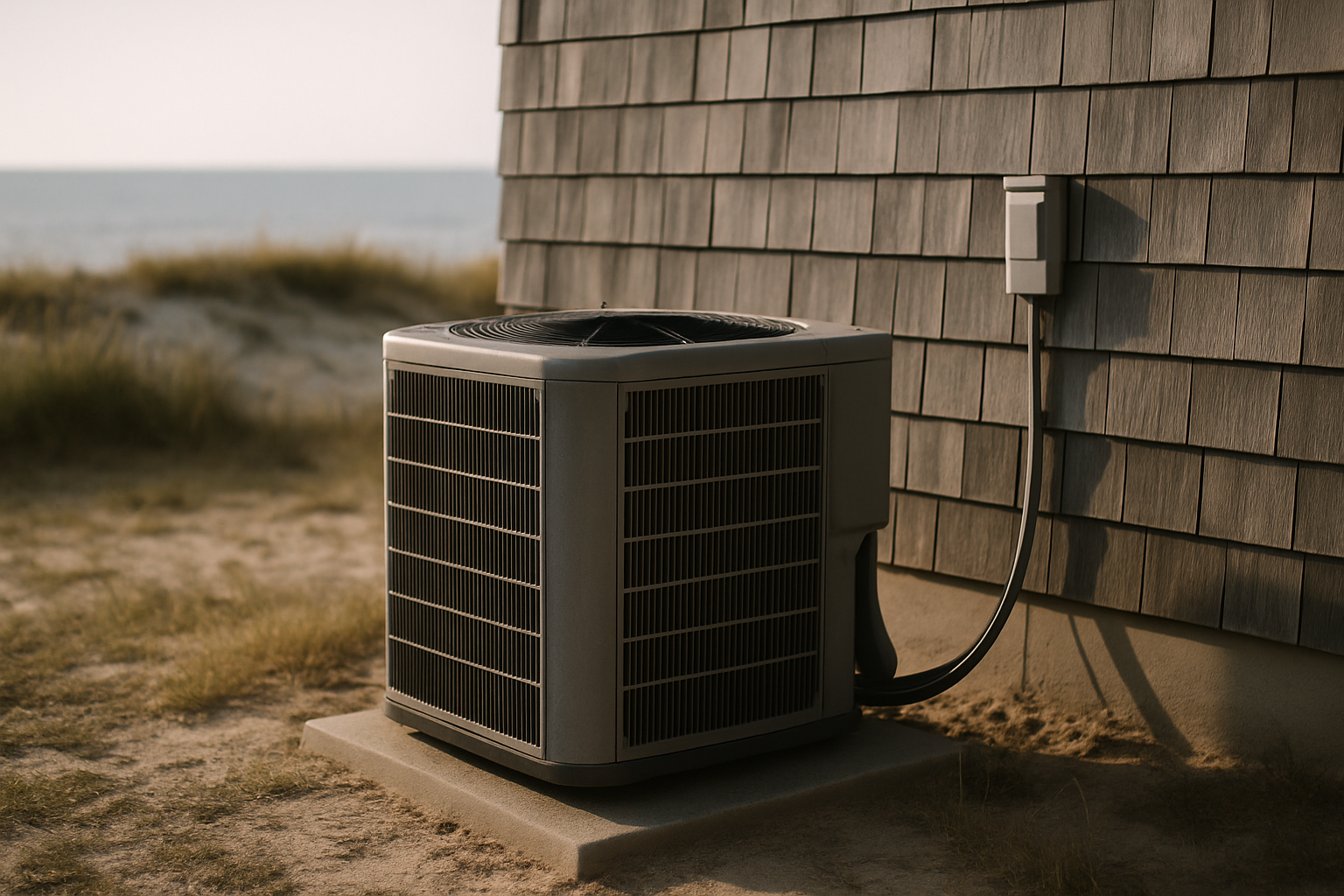
Coastal-Rated Condenser Installation: Spec, Siting and Flood Elevation at the NJ Shore
A coastal-rated condenser is an outdoor AC or heat pump unit built for salt air: a factory-coated coil, corrosion-resistant cabinet, stainless or coated fasteners, and a better-sealed electrical compartment. At the NJ shore, that installation spec only pays off if flood elevation, placement, clearances, and a rinse schedule are settled before the unit is ordered.
A coastal-rated condenser is an outdoor AC or heat pump unit built for salt air: a factory-coated coil, corrosion-resistant cabinet, stainless or coated fasteners, and a better-sealed electrical compartment. At the NJ shore, that installation spec only pays off if flood elevation, placement, clearances, and a rinse schedule are settled before the unit is ordered.
What does "coastal-rated" actually mean on a condenser?
"Coastal-rated" is a specification, not a sales sticker. On models built for exposed shore addresses, the outdoor coil carries a factory-applied protective coating across the fin pack. The cabinet uses a heavier corrosion-resistant finish. Fasteners are upgraded to stainless or coated hardware. The electrical compartment is sealed more thoroughly against airborne moisture.
Those four changes target the four places salt air attacks an outdoor unit: fin material, cabinet steel, fasteners and base pans, and electrical contacts. Carrier, Trane, Daikin, Mitsubishi and several other manufacturers publish coastal or seacoast variants of popular product lines, so the option exists across major brands rather than from one niche supplier.
Not every manufacturer uses the same name. Some call it a seacoast model, others a coastal package or a corrosion-resistant build. The spec sheet, not the sales name, is what matters.
| Component | Standard condenser | Coastal-rated or seacoast variant |
|---|---|---|
| Coil and fin pack | Standard coil | Factory-applied protective coating across the fin pack |
| Cabinet | Standard finish | Heavier corrosion-resistant finishing |
| Fasteners and hardware | Standard hardware | Stainless or coated hardware |
| Electrical compartment | Standard seal | Sealed more thoroughly against airborne moisture |
| Intended environment | Inland installation | Exposed shore address |
The exact coating system, cabinet treatment and fastener specification vary by manufacturer and model. That is not a reason to skip the question. It is the reason to confirm the specific coastal build on the quoted unit before you approve the estimate.
Do you actually need a coastal-rated condenser at the NJ shore?
Not every Atlantic County home needs one. The decision turns on actual salt exposure at the address, not on the county line.
Barrier island homes in Atlantic City, Ventnor City, Margate City, Longport and Brigantine sit in the harshest residential environment in New Jersey. Salt aerosol settles on the outdoor coil and cabinet, and over time it corrodes fin material, rusts fasteners and base pans, and pits electrical contacts. It is common for a condenser two blocks from the beach to age twice as fast as the identical unit ten miles inland in Egg Harbor Township. That is the pattern behind how long an AC lasts near the ocean in New Jersey, and it is the strongest argument for a coastal build.
Bayfront homes near Great Egg Harbor Bay face the same mechanism from brackish air rather than open-ocean spray. In towns such as Somers Point, the salt load is real even when the ocean is out of sight.
Mainland neighborhoods in Egg Harbor Township, Pleasantville, Galloway, Hammonton and Mays Landing sit farther from the salt source. A standard condenser is often appropriate there, but the question should still be answered on site. Prevailing wind, distance to open water, and whether the unit sits in a sheltered pocket change the answer more than the town name does.
The right framing is: how much salt actually reaches the unit, and does the coastal build's extra service life justify its real upcharge? The upcharge is real, and so is the extra service life, which is why the conversation belongs in the estimate rather than after the fact.
Why a like-for-like swap is the wrong starting point at the shore
The most expensive mistake in shore AC replacement is treating the job as a swap of identical equipment. A condenser two blocks from the beach can age twice as fast as the identical unit ten miles inland. The failure is not bad luck; it is the environment.
Salt aerosol settles on the condenser coil and cabinet. Over time it corrodes fin material, rusts fasteners and base pans, and pits electrical contacts. A standard unit installed in that same environment will follow the same failure path as the one being removed. Replacing it with the same build, in the same location, resets the clock on the same problem.
A coastal replacement starts from the environment instead of the equipment. What is the salt exposure? What elevation does flood protection require? Where can the unit physically go? Which build option is designed for that condition? Those questions change the equipment selection, the placement, the mounting, and the maintenance plan. Resolve them before equipment is discussed, and the replacement lasts longer and the estimate reflects the real job.
For the wider picture of what does and does not slow corrosion at the shore, see coastal HVAC corrosion protection at the NJ shore. This page stays focused on the condenser itself: how to spec it, where to put it, and what the install must get right.
How to read the spec sheet instead of the sales name
The manufacturer names vary: seacoast model, coastal package, corrosion-resistant build. The words are not the spec. Before approving a quote, confirm four things on the quoted model:
- The coil coating is factory-applied across the fin pack. Factory application matters because it is part of the manufacturing process, not a dealer-applied treatment that covers only the exposed faces.
- The cabinet finish is specified as corrosion-resistant, not described with an adjective in the sales line.
- The fasteners are stainless or coated, including the hardware that holds the base pan and panels.
- The electrical compartment is sealed more thoroughly against airborne moisture, which is part of the coastal build rather than a field modification.
Ask for the model number and the manufacturer's coastal or seacoast option code, and require it in writing on the estimate. The estimate should name the coating and the build option. If the quote says only "corrosion-resistant unit," ask which specification makes it corrosion-resistant. A real coastal build answers that question from the data sheet.
How salt air changes the condenser installation
Salt aerosol is the dominant variable on the barrier islands and along the bayfront. Airborne salt settles on metal, holds moisture, and accelerates corrosion at the fins, fasteners, base pan and electrical connections.
That changes two decisions. First, the equipment should be specified with corrosion-resistant or coated coils and treated cabinets — options the major manufacturers build for coastal markets. Second, placement does real work: siting the outdoor unit with some shelter from direct spray, keeping code-required clearances, and committing to periodic fresh-water coil rinses meaningfully extends equipment life within a few blocks of the ocean.
Installation quality is the third variable. The same equipment installed poorly will fail years earlier than a properly installed system. NATE-certified technicians following manufacturer specifications on every job protect the value of the coastal-rated equipment, and installations are backed by a 10-year warranty.
Flood-zone elevation, stand height, and mounting
Flood-zone elevation is set by the property's flood zone and design flood elevation, not by a standard guess. FEMA's National Flood Insurance Program mapping identifies the flood zone. New Jersey's flood-resistant construction standards and each municipality's floodplain ordinance turn that mapping into a required elevation for mechanical equipment. The authoritative numbers come from the elevation certificate or the local floodplain administrator for the specific address.
The practical question on a condenser install is how high the unit must sit to stay clear of flood water. Stand height, bracket height, and whether the platform needs to be engineered rather than improvised all follow from that requirement, the equipment weight, and the exposure.
Elevating the condenser changes the rest of the job. When the unit goes up on a deck, stand or bracket, the installation must account for line-set length and support. A longer or higher line-set run changes refrigerant piping, insulation and service access. The electrical disconnect and wiring route change with the elevation. Service access changes too, because a unit set high on a stand is harder to reach than one on a ground pad.
The sequence matters: resolve flood elevation and mounting before equipment is selected. A unit that will not fit on the required stand, or a stand that will not clear the design flood elevation, should be discovered at the estimate, not on installation day.
Stands, brackets, and materials that survive salt air
The platform that holds the condenser is part of the same coastal environment as the equipment. Stand and bracket materials and connections should be specified for salt exposure, not just for height. An improvised support that clears the flood requirement but corrodes at its fasteners becomes a future service problem.
Engineered or purpose-built stands address two requirements at once: they hold the unit at the required elevation and they do it with materials and connections that tolerate the environment. The installer should confirm both before the platform is built or ordered.
Where to put the condenser: salt shelter vs. airflow clearances
Placement is where salt protection and airflow requirements meet. Siting the outdoor unit with some shelter from direct spray extends equipment life where the lot allows. But shelter cannot come at the expense of manufacturer clearances. The unit must keep the clearances published in the manufacturer's installation instructions for airflow, service access and safe operation, and it must keep code-required clearances as well.
Barrier island lots make this harder than it sounds. A narrow side yard forces the question of where the condenser can physically go. A neighbor's wall can create a pocket where hot discharge air recirculates and destroys efficiency. A position that looks sheltered may actually trap salt-laden air against the coil or starve the unit of airflow.
The decisions to review together:
- Direct salt spray exposure and available shelter
- Manufacturer-required clearances on every side of the unit
- Discharge air path and recirculation risk from nearby walls or structures
- Side-yard, property-line and access constraints
- Flood elevation and the location of any required stand or bracket
- Refrigerant line-set and electrical run distance from the indoor equipment
Each of these trades against the others. The goal is not maximum shelter at any cost. It is the best position that keeps manufacturer clearances intact and reduces direct salt spray where the lot allows.
Electrical near salt water: disconnect, sealed compartment, grounding
Coastal-rated units seal the electrical compartment more thoroughly against airborne moisture. That is part of the factory build, but it only protects the compartment it covers. The field wiring, disconnect and grounding connections are installed on site and face the same salt exposure.
The outdoor disconnect must be located and rated according to the manufacturer's installation instructions and the local electrical inspection requirements. In a coastal environment, the disconnect enclosure and its connections are exposed to the same airborne moisture that attacks the condenser. A protected, corrosion-resistant enclosure with sealed penetrations matters more near salt water than it does inland. Conduit and cable entries should be sealed so airborne moisture does not migrate into the compartment.
Grounding and bonding connections need the same attention. Corrosion at a ground connection can degrade the path over time, even when the connection looked fine at installation. The connections should be protected and then inspected as part of routine maintenance, not only when a problem appears.
Ask the installer how the electrical work is being specified for salt air, not just whether it will pass inspection. The inspection confirms the work is safe on the day it is done; the coastal specification is what keeps it reliable in the years after.
Permitting at shore municipalities
Shore municipalities run separate construction offices and apply different review paths. Barrier island towns such as Atlantic City, Ventnor City, Margate City, Longport and Brigantine are separate jurisdictions from bayfront boroughs like Somers Point and from mainland towns including Egg Harbor Township, Pleasantville and Galloway.
Whether a condenser replacement or new installation requires a permit, and which trade files it, varies by municipality. Work that involves flood-zone elevation can add a review step in some towns and not in others. The correct answer for one shore town is not automatically the correct answer for the town next door.
The practical rule is to confirm the requirement and the filing path before work starts. Never assume the mainland process applies on a barrier island, and never assume two adjacent shore towns handle permitting the same way. The installer should be able to identify the correct jurisdiction, the required application and any floodplain review before the equipment is ordered.
What the installation includes — and what it does not
A coastal-rated condenser installation should include more than the equipment swap. The useful scope covers the decisions that determine whether the unit survives the environment.
Included in the job:
- Site assessment of flood elevation, clearances and salt spray exposure
- Coastal-rated equipment selection with the manufacturer's coastal build option confirmed
- Elevated placement on stands or brackets where flood considerations require it
- Line-set routing and support for elevated units
- Electrical work specified for the salt environment, including the disconnect and grounding
- Commissioning and start-up checks per manufacturer specifications
- A corrosion-rinse handoff and, where chosen, a maintenance plan with scheduled tune-ups
What is not automatic:
- Coastal-rated equipment is an option, not a default. The upcharge is real and belongs in the estimate before work starts.
- Ideal shelter from salt spray is not always available on a small barrier island lot.
- Elevation height is not a standard number. It is set by the property's flood zone and design flood elevation.
Pricing is flat-rate and quoted up front before any work starts. Installations carry a 10-year warranty, and the work is performed by a licensed and insured NJ contractor with EPA-certified and NATE-certified technicians.
The installation process, step by step
- Site survey and flood-zone review. The installer walks the lot, measures clearances, identifies salt spray exposure, and confirms the flood zone and design flood elevation from the elevation certificate or local records.
- Equipment selection. The coastal build option is confirmed on the quoted model: coil coating, cabinet finishing, fasteners and sealed electrical compartment, with the system sized for the house rather than copied from the old unit.
- Permit and elevation confirmation. The correct filing path is confirmed with the local construction office, including any floodplain review the municipality requires.
- Stand, bracket and line-set engineering. If the unit must be elevated, the installer confirms the platform and accounts for line-set length, support and service access.
- Installation day. The condenser is set at the approved elevation and placement, manufacturer clearances are maintained, and the electrical work is completed to local inspection requirements.
- Commissioning and start-up. The system is started and checked per the manufacturer's published specifications, not just switched on.
- Corrosion-rinse handoff. The owner receives a rinse and maintenance plan. For owners who want it handled, the rinse is built into scheduled tune-ups.
What to have ready before the estimate
- The elevation certificate, if the property has one
- The flood zone determination or FEMA panel information for the address
- Property-line and side-yard dimensions, or a recent survey
- The existing equipment model and photos of the current location
- Access notes: gates, narrow yards, deck clearance, and any need for a lift or two-person carry
- The municipality where the work will be permitted
Having these ready lets the installer resolve elevation, placement and permitting questions before equipment is discussed. That is the difference between an estimate that holds and one that has to be revised after the site visit.
Questions to ask before you approve the install
- Is the quoted unit a factory coastal or seacoast variant, and which specific build options does it include?
- What elevation does the flood zone require, and what is the stand or bracket height based on?
- Does the platform need to be engineered, and who confirms that?
- Where will the unit sit, and which manufacturer clearances apply?
- How will the line-set be routed and supported if the unit is elevated?
- How is the electrical work specified for salt air, including the disconnect and grounding?
- Which municipality issues the permit, and who files it?
- What does the commissioning and start-up check include?
- Is the fresh-water coil rinse included in the maintenance plan, and how often is it performed?
Asking these before work starts surfaces the coastal-specific decisions that a standard estimate often leaves out.
Commissioning and the corrosion-rinse handoff
Commissioning is the point where the installation is verified rather than merely switched on. The start-up checks follow the manufacturer's published specifications. For a coastal-rated unit, the installer should confirm that the sealed electrical compartment is intact, the coil coating is undamaged after handling, and the unit is level and secure on its stand or bracket with clearances intact.
The handoff should include the single most valuable shore habit: periodic fresh-water rinsing of the coil. Salt aerosol that settles on the coil can be rinsed away before it accumulates into corrosion. The rinse is built into a maintenance plan with scheduled tune-ups for owners who want it handled for them.
Seasonal and rental properties add another layer. Freeze protection and monitoring, plus smart thermostat controls that let you check on the home from anywhere, protect a shore home that is empty between visits. For the full picture, see the buyer's guide to second home HVAC freeze protection at the NJ shore. The same coastal maintenance plan that protects the condenser can include those controls.
Maintenance: the other half of coastal life
Coastal-rated equipment still lives in salt air, so it still needs maintenance. The factory coating and sealed compartment reduce the corrosion load; they do not remove it. The maintenance plan is where the remaining risk is managed.
Scheduled tune-ups should include a fresh-water rinse of the coil, an inspection of fasteners, base pan and electrical connections for corrosion, and a check that the stand or bracket and line-set support are intact. A seasonal property needs the same visits timed around occupancy, not skipped because the house is empty.
The 10-year installation warranty is the backstop, but it is not a substitute for the rinse schedule. The rinse is a low-cost life-extension habit at the shore.
What about heat pump and mini-split outdoor units?
The same rules apply to any outdoor unit. A heat pump condenser sits outside in the same salt air and carries the same coil, cabinet, fastener and electrical exposure. Heat pump installation in bayfront towns is sized for bayfront temperature swings, with corrosion-aware condenser care for brackish air off Great Egg Harbor Bay.
Ductless mini-splits put the outdoor unit through the same environment. They suit duplexes, condos, additions and rooms without ductwork, including the tight mechanical spaces common in shore construction. For older shore homes, ductless mini-splits for historic New Jersey homes follow the same coastal equipment and placement questions for the outdoor units.
The coastal build option is confirmed on whatever outdoor unit the system uses, not only on a conventional central AC condenser.
Where this service is offered
The service covers South Jersey shore and bayfront communities. That includes the barrier island towns of Atlantic City, Ventnor City, Margate City, Longport and Brigantine; bayfront communities near Great Egg Harbor Bay such as Somers Point; and mainland areas including Egg Harbor Township, Pleasantville and Galloway. The same principles apply to any New Jersey shore home, from an ocean-block lot to a bayfront property.
Scheduling and what drives the timeline
Lead time depends on equipment availability from the manufacturer, permit review, and any stand or bracket fabrication or engineering. A like-for-like replacement in a straightforward jurisdiction may move faster than an elevated relocation that requires floodplain review. The installer confirms the schedule after the site survey and the permit path are known.
Frequently asked questions
Is coastal-rated air conditioning equipment worth the extra cost?
The upcharge is real, and so is the extra service life. A coastal-rated or seacoast unit carries a factory-applied coil coating, a heavier corrosion-resistant cabinet finish, stainless or coated fasteners and a better-sealed electrical compartment. Near the ocean, a condenser two blocks from the beach can age twice as fast as an identical inland unit, so the extra cost buys meaningful life rather than a label.
Why does HVAC equipment wear out faster near the shore than inland?
Salt aerosol settles on the outdoor coil and cabinet, corrodes fin material, rusts fasteners and base pans, and pits electrical contacts. A condenser two blocks from the beach can age twice as fast as the identical unit ten miles inland in Egg Harbor Township. Bayfront homes face the same mechanism from brackish air off Great Egg Harbor Bay.
Do HVAC replacements at the shore require permits?
It depends on the municipality. Barrier island towns, bayfront boroughs and mainland towns run separate construction offices with different review paths, and flood-zone work can add a review step in some towns. The installer should confirm the requirement and the filing path before work starts.
How do I protect a seasonal shore home from winter freeze damage?
Freeze protection and monitoring are available for seasonal and rental properties, and smart thermostat controls that let you check on the home from anywhere let an owner watch the home between visits. The same maintenance plan that includes fresh-water coil rinses can include those seasonal protections.
Do these rules apply to heat pumps?
Yes. A heat pump's outdoor unit sits in the same salt air and carries the same coil, cabinet, fastener and electrical exposure. In bayfront locations such as Somers Point, heat pump installation is sized for bayfront temperature swings, with corrosion-aware condenser care for brackish air off Great Egg Harbor Bay.
Can you install ductless mini-splits in shore homes?
Yes. Ductless mini-splits suit duplexes, condos, additions and rooms without ductwork, including the tight mechanical spaces common in shore construction. The same coastal equipment and placement questions apply to the outdoor units, and the coastal build option should be confirmed on the quoted model.
Next step
Call (609) 525-4521 to schedule a coastal condenser assessment or request a flat-rate quote, or use the 24/7 line for emergency no-cooling calls. The estimate conversation should cover the equipment spec, flood elevation, placement and the maintenance plan together, so the number you approve is the number you pay.