Whole-home air purifier in Atlantic County NJ: MERV ratings, media filters, and what actually helps
A whole-home air purifier in Atlantic County NJ is a duct-mounted filtration upgrade that treats the air your HVAC system already moves. For most shore homes, the useful core is a MERV 11–13 media filter matched to the blower, not a gadget. Filtration captures particles. It cannot remove the coastal moisture that feeds mold and musty smells.
A whole-home air purifier in Atlantic County NJ is a duct-mounted filtration upgrade that treats the air your HVAC system already moves. For most shore homes, the useful core is a MERV 11–13 media filter matched to the blower, not a gadget. Filtration captures particles. It cannot remove the coastal moisture that feeds mold and musty smells.
What is a whole-home air purifier in Atlantic County NJ?
A whole-home air purifier is not a box you plug into one bedroom. It is filtration and air-cleaning equipment mounted in the ductwork so that every cubic foot of air the heating and cooling system circulates passes through it. In Atlantic County, where homes run the air conditioner for months and close windows against shore humidity, the duct system is already the main route air takes through the house. Putting the filter there means the whole house gets treated instead of one room.
HappyVac's indoor air quality work groups whole-home air cleaning into a few tiers. High-efficiency media air cleaners use deep pleated cartridges and push capture rates toward HEPA territory while preserving airflow. Polarized-media and electronic air cleaners charge fine particles so they are captured more efficiently at lower resistance. Some systems add activated-carbon stages that adsorb odors and volatile organic compounds.
This equipment is for homeowners with ducted heating and cooling who want one system rather than a portable purifier in each room. It is not for homes without ductwork, and it is not a moisture-removal appliance. A purifier moves air and catches particles; a dehumidifier removes water vapor. Those are different jobs, and at the shore the second job often matters more.
What MERV rating should an Atlantic County home use?
MERV stands for Minimum Efficiency Reporting Value. It is the standard scale for how well a filter captures particles, running from 1 to 16 for residential-class filters. The number describes capture efficiency, not a health claim.
The cheap woven-fiberglass filters that come with many systems sit around MERV 2 to 4 and catch only large debris. MERV 8 captures dust and pollen respectably. MERV 11 adds finer dust, most mold spores, and pet dander. MERV 13 captures smoke particles, bacteria-sized particulates, and the fine aerosols that health guidance has focused on in recent years.
For most Atlantic County families, the useful range is MERV 11 to 13. That is the sweet spot between air cleaning and airflow. The reason the range matters at both ends: too low a rating leaves the particles you care about in circulation, and too high a rating can choke a blower that was not sized for it.
| MERV rating | What it captures | Typical role in an Atlantic County home |
|---|---|---|
| MERV 2–4 | Large debris only | Basic protection for the equipment, not air cleaning |
| MERV 8 | Dust and pollen | Entry-level filtration for a standard one-inch slot |
| MERV 11 | Finer dust, most mold spores, pet dander | Good all-around filter for allergy seasons |
| MERV 13 | Smoke particles, bacteria-sized particulates, fine aerosols | Practical ceiling for most residential blowers; strongest particle capture |
Why does a higher MERV filter carry a pressure-drop tradeoff?
A MERV rating is not a free upgrade. Higher MERV means finer, denser media, and finer media resists airflow. That resistance is called pressure drop. The blower has to push against it, and when the resistance climbs past what the blower can handle, airflow falls. Lower airflow can mean longer runtimes, higher energy use, and extra strain on the motor.
That is why MERV 13 is described as the practical ceiling for most residential blowers. It is not that MERV 13 is dangerous; it is that the filter and the blower have to be chosen together. The same rating that works in a properly matched media cabinet can be a problem as a thin one-inch filter in an older furnace with a marginal blower.
The way around the tradeoff is surface area. A deep pleated cartridge spreads the same MERV rating across more media, so air has more paths through the filter. That is the idea behind a media cabinet: high capture rates toward HEPA territory while preserving airflow. If you want MERV 11 or 13 filtration and the blower is not oversized, a deep media cabinet is usually the safer way to get it than cramming a high-MERV filter into a one-inch slot.
Media cabinet vs one-inch filter vs electronic air cleaner: what actually differs?
The differences come down to how the device captures particles, what it adds, and what it asks of the blower and the homeowner.
A one-inch filter drops into the existing filter slot. It is the easiest upgrade and the most constrained. Because a one-inch filter has limited media area, a high-MERV one-inch filter is more restrictive than the same rating in a deep cartridge. One-inch filters suit homes that cannot physically fit a media cabinet and need a modest rating, or homes where a standard MERV 8 to 11 filter is enough.
A media cabinet holds a deep pleated cartridge. The extra media area allows finer capture with less pressure drop. HappyVac describes these as pushing capture rates toward HEPA territory while preserving airflow. Note the word "toward": a media cabinet is not a true HEPA filter, but it approaches that level of particle capture in a form a residential blower can actually move air through.
Electronic and polarized-media air cleaners work differently. They charge fine particles so they are captured more efficiently at lower resistance. That lower-resistance benefit matters in homes where ductwork is already tight. What they do not do automatically is remove gases; odor and VOC removal requires an activated-carbon stage. The collection surfaces also need regular cleaning or replacement, or capture falls off.
Activated-carbon stages are not particle filters. They adsorb odors and volatile organic compounds. The site calls them valuable for households sensitive to smells, homes with attached garages, and anyone who notices lingering cooking and pet odors.
| Device class | What it does | What it does not do | Best fit |
|---|---|---|---|
| One-inch high-MERV filter | Captures particles in the existing slot | Limited media area; more restrictive at high MERV; no gas removal | Homes that cannot fit a media cabinet |
| Deep media cabinet | High particle capture toward HEPA territory while preserving airflow | Not gas removal unless carbon is added | Most whole-home particle filtration upgrades |
| Electronic / polarized-media cleaner | Charges fine particles for capture at lower resistance | No gas removal by itself; collection surfaces need cleaning | Tight-duct homes that need lower resistance |
| Activated-carbon stage | Adsorbs odors and VOCs | Does not capture particles on its own | Odor-sensitive homes, attached garages, pet and cooking smells |
| UV germicidal light | Treats surfaces inside the air handler | Not a whole-air particle filter | Mold growth on the wet coil and drain pan |
Do UV air purifiers in HVAC systems clean the air?
UV has a narrow, real job. UV germicidal lights stop mold growth inside the air handler. That is surface treatment, aimed at the wet coil and drain pan where mold wants to grow in a coastal climate.
What UV does not do is replace a filter. It does not pull dust, pollen, or smoke particles out of the airstream. If the complaint is allergy particles or visible dust, the answer is a MERV 11 to 13 filter, not a lamp. If the problem is microbial growth on the coil, UV is aimed at the right surface, but it is a supplement to filtration, not a substitute.
Photocatalytic oxidation (PCO) devices are sometimes sold as whole-air purifiers. They work on gases rather than particles, and their real-world performance depends on the specific chemistry, airflow, and how long air actually spends in the device. Ask what a PCO device is tested to do in real duct conditions before treating it as a substitute for a media filter. The honest default for particles is still filtration.
Why does shore humidity come before filtration?
From late May through September, outdoor dew points along the shore sit high enough that any air leaking into an Atlantic County home carries a heavy moisture load. Indoors, that moisture condenses on cool surfaces: AC supply ducts, crawlspace framing, basement walls, the back of closets on exterior walls. Sustained surface moisture is all mold needs. Once indoor relative humidity spends time above 60 percent, mold and dust mites flourish. The comfortable target zone is roughly 40 to 50 percent in summer.
A whole-home air purifier cannot fix that. It can catch mold spores that are already airborne, but it cannot stop the damp surface that keeps producing them. This is the most important sequence in the whole decision: in a shore home, moisture is the source, and particles are often the symptom.
A whole-home dehumidifier ties into the ductwork and drains automatically, removing water from the air whether or not the air conditioner is running. Set a target, say 48 percent relative humidity, and the unit holds it through muggy June mornings, rainy nor'easter stretches, and shoulder-season weeks when it is 72 degrees and swampy outside. Mold loses its habitat, dust mites decline, musty odors fade, and the house feels crisper at higher thermostat settings, which trims cooling costs.
The practical order for a shore home is control humidity first, then filter. A media filter and a whole-home dehumidifier are complements. A purifier alone in a damp house is an expensive way to catch spores while the source keeps producing them.
How is whole-house air filtration sized for a shore home?
Sizing is not just choosing a MERV number. It starts with the existing system and the space around it.
Filter location and access come first. The filter may live in a return grille, in a slot at the air handler, or in the return drop. A media cabinet needs physical room in that path. If the cabinet cannot be reached easily for replacement, the maintenance schedule will slip, and a neglected filter becomes a restriction.
Blower capacity is the hard limit. MERV-rated filtration upgrades are matched to the blower's capacity. A blower that is already near its airflow limit cannot absorb a more restrictive filter. That is why the assessment matters before the product choice.
Duct condition matters too. Leaky or undersized ducts already cost airflow. Adding a high-MERV filter on top of bad ducts compounds the problem. The air quality assessment evaluates duct condition alongside humidity, filtration, and ventilation.
Replacement cadence is part of sizing, because the cadence has to be realistic for the household. A deep pleated cartridge holds more dust than a one-inch filter, so it is changed less often. The actual interval depends on filter depth and media area, the home's dust load, pets, and how much the system runs. A schedule should be set from those facts, not from a generic calendar.
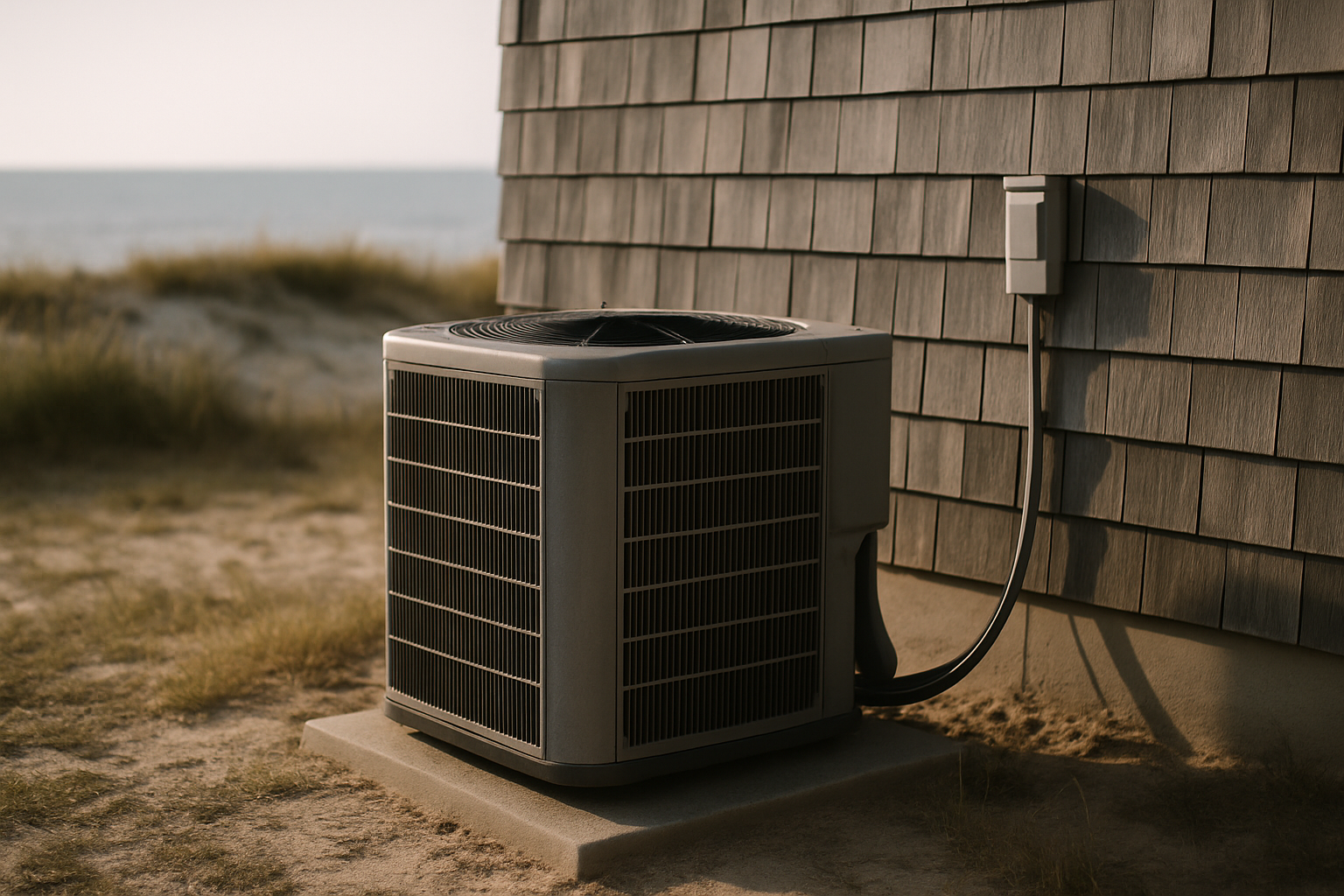
Finally, a shore home is specified as a whole. Indoor filtration equipment sits inside the conditioned space and is protected from salt spray, but the outdoor unit still faces the barrier-island environment where salt air shortens equipment life and placement decisions matter. Filtration is one part of a system that has to survive the coast, not a standalone purchase.
Which device matches which problem: allergies, smoke, and musty seasonal homes?
The right device depends on the problem, and the problem is usually specific.
For allergies in Atlantic County, the HVAC filter has to handle a real particle load: pine and oak pollen drifting off the Pinelands, plus the mold spores and pet dander that accumulate in closed-up shore homes. MERV 11 adds finer dust, most mold spores, and pet dander; MERV 13 adds the finer fractions. A MERV 11 to 13 media filter is the workhorse here, and a deep cabinet keeps the airflow penalty down during allergy season.
For wildfire smoke, MERV 13 is the rating that captures smoke particles. Filtration only helps while air is actually moving through the filter, so during smoke events the fan should run on recirculate with a MERV 13 filter in place. This is a particle problem, not a gas problem, and a carbon stage is a separate decision if odor is the complaint.
For the musty seasonal shore house, the problem is moisture. The musty smell when you arrive is a humidity signal, not a filter signal. The fix is a whole-home dehumidifier first, then a MERV 11 filter to catch the spores that are already circulating. A purifier alone will not fix the smell.
For odors and VOCs, an activated-carbon stage is the relevant device. The site points to it for households sensitive to smells, homes with attached garages, and lingering cooking and pet odors.
| Problem | Right device class | What it actually does |
|---|---|---|
| Pollen, dust, pet dander | MERV 11–13 media filter | Captures the particle load while the blower runs |
| Wildfire smoke | MERV 13 filter, fan on recirculate | Captures smoke particles from circulated air |
| Musty seasonal shore house | Whole-home dehumidifier first, then MERV 11 filter | Removes the moisture source, then catches spores |
| Odors, attached garage, cooking and pet smells | Activated-carbon stage | Adsorbs odors and VOCs |
| Mold on the air handler coil | UV germicidal light | Treats the wet coil surface, not the whole airstream |
What maintenance does a whole-home air purifier need?
A whole-home air purifier is only as good as its maintenance. Each device class has a different failure mode when neglected.
Media filters load up. A deep cartridge holds more dust than a one-inch filter, so it is changed less often, but it still has to be changed. A loaded filter increases pressure drop and eventually costs airflow. The replacement interval should be set from the home's dust load, pets, and runtime.
Electronic and polarized-media cleaners have collection surfaces that need cleaning or replacement. When those surfaces are dirty, the capture advantage disappears. A device that charges particles but collects them on a fouled surface is not cleaning the air.
Carbon stages saturate. Carbon adsorbs until it cannot adsorb more, then it stops working. It needs replacement on a schedule, not when you notice the smell return.
UV lamps lose output over time. A lamp that has aged past its useful output is not treating the coil surface anymore. Replacement is part of the plan, not an optional add-on.
Finally, the rest of the system still needs seasonal maintenance. A better filter does not replace coil cleaning, drain pan care, or blower service. The filter protects the coil, but it does not eliminate the need to maintain it. The honest expectation is this: a whole-home purifier reduces the particle load in circulated air and keeps the equipment cleaner. It is not a medical device, and this site makes no health claims for it. Its value is mechanical: cleaner air, cleaner equipment, and fewer particles recirculating when the humidity problem is already under control.
How the HappyVac air quality assessment works
The first step is an air quality assessment. Technicians evaluate humidity levels, filtration, duct condition, and ventilation. They also listen: allergies, musty smells, dust complaints, and condensation clues all point to specific causes that can be verified. That step comes before any product recommendation, because the recommendation has to match the home, not the catalog.
From the assessment, the recommendation follows. MERV-rated filtration upgrades are matched to the blower's capacity, so the filter choice is constrained by what the system can actually move. The work is installed by EPA-certified technicians, with upfront pricing.
Maintenance follows installation. The replacement cadence is set from the home's dust load and the device class, and the technician leaves a schedule that is realistic to keep. The sequence is assessment first, then a matched recommendation, then installation, then maintenance. No step skips the constraint that the blower and the filter have to work together.
Where whole-home air purification is available in Atlantic County
HappyVac serves all of Atlantic County, NJ. That includes mainland towns such as Egg Harbor Township, Galloway, Hammonton, Northfield, Linwood, Somers Point, Absecon, Pleasantville, Mays Landing, Mullica Township, Buena, Hamilton Township, Egg Harbor City, Folsom, Estell Manor, Weymouth Township, and Port Republic. It also includes the barrier-island communities of Atlantic City, Ventnor City, Margate City, Brigantine, and Longport.
The barrier islands carry the strongest version of the shore problem: salt air, constant humidity, and homes that sit closed for part of the year. Mainland homes deal with Pinelands pollen and the same summer moisture load. The right sequence does not change, but the intensity does, which is why the assessment looks at the actual home rather than applying one Atlantic County setting to every house.
Frequently asked questions about whole-home air purifiers
Will a MERV 13 filter damage my furnace?
Not automatically. MERV 13 is the practical ceiling for most residential blowers, which means the filter and the blower have to be matched. A technician should verify that the system can move air through the filter before the upgrade. A deep media cabinet delivers MERV 13-level capture with more surface area and less pressure drop than a one-inch MERV 13 filter in a marginal system.
Do electronic air cleaners work better than media filters?
They work differently, not automatically better. Electronic and polarized-media cleaners charge fine particles so they are captured more efficiently at lower resistance, which helps in tight-duct homes. They do not remove gases unless carbon is added, and their collection surfaces need regular cleaning. A deep media cabinet is simpler and still pushes capture toward HEPA territory while preserving airflow.
Does a whole-home air purifier fix a musty shore house?
Not by itself. Musty odors are usually a moisture problem. Above 60 percent relative humidity, mold and dust mites flourish. A whole-home dehumidifier set around 48 percent removes the condition that produces the smell; a MERV 11 filter then catches the spores already circulating. The purifier captures particles; the dehumidifier removes the moisture that keeps making them.
Do UV lights replace an air filter?
No. UV germicidal lights stop mold growth inside the air handler. That is surface treatment on the wet coil and drain pan, not particle removal from the airstream. UV does not remove dust, pollen, or smoke particles. A MERV 11 to 13 filter and a UV lamp are complementary: the filter handles particles, and the lamp handles coil-surface mold.
How often do whole-home media filters need to be replaced?
The interval depends on filter depth, media area, the home's dust load, pets, and how much the system runs. Deep pleated cartridges hold more dust than one-inch filters, so they are changed less often. A schedule should be set from an assessment of the actual home, not from a generic calendar interval.
Is a whole-home system better than a portable air purifier?
For whole-house coverage, yes, when the home has ductwork. A duct-mounted system treats every cubic foot of circulated air in every room, while a portable unit cleans the room it sits in. The tradeoffs are installation and blower compatibility. The whole-home approach matches this site's stated position: treat every room, not just one.