
Why Air Conditioners Rust Near the Ocean — and What Actually Stops It
Air conditioners rust near the ocean because salt aerosol settles on the outdoor coil and cabinet, absorbs shore humidity, and attacks fins, fasteners, and electrical contacts. The fix is a stack: a factory coastal package with coated coils and sealed electrics, sheltered placement with proper clearances, and scheduled fresh-water rinses. Specify it before install, not after failure.
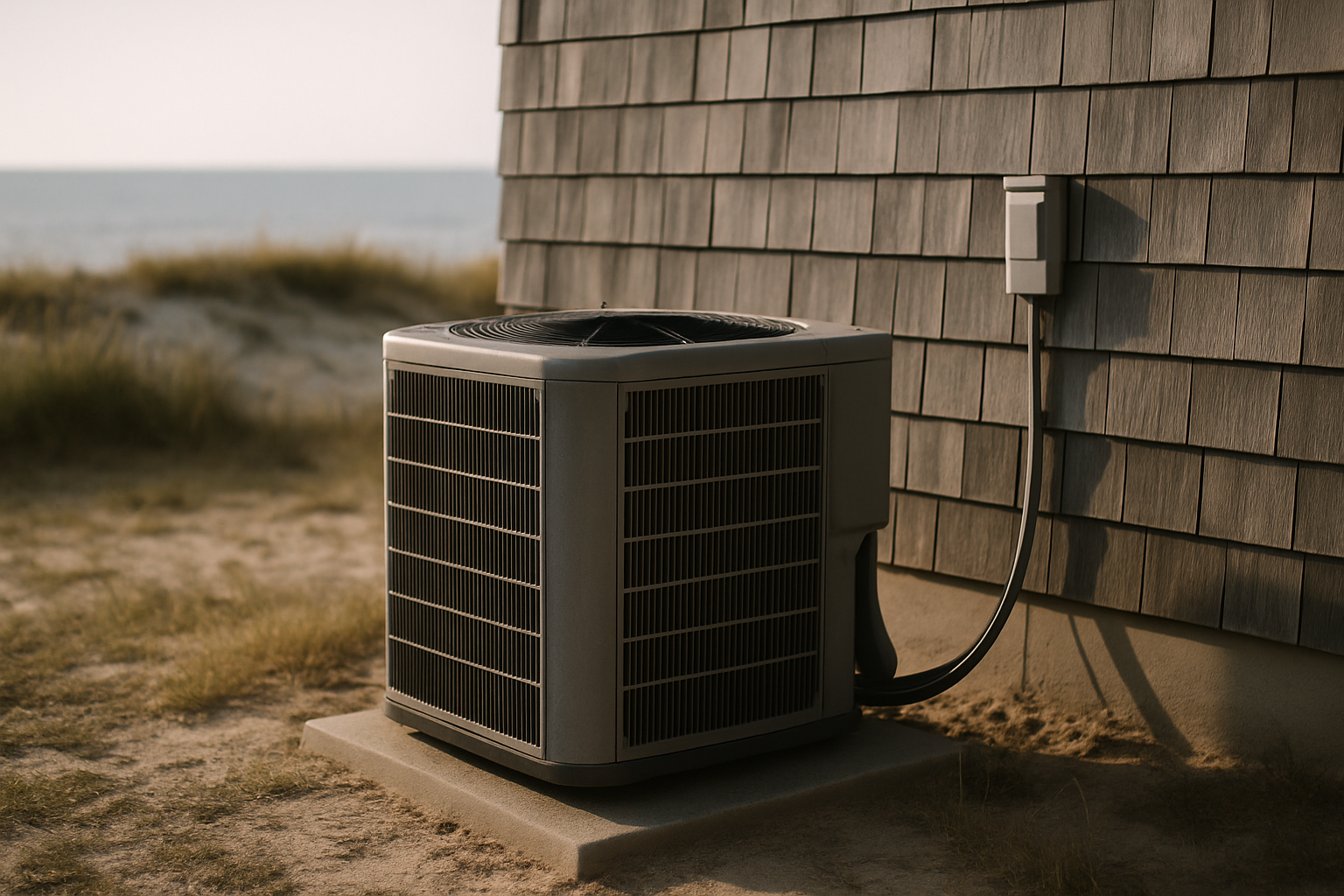
Air conditioners rust near the ocean because salt aerosol settles on the outdoor coil and cabinet, absorbs shore humidity, and attacks fins, fasteners, and electrical contacts. The fix is a stack: a factory coastal package with coated coils and sealed electrics, sheltered placement with proper clearances, and scheduled fresh-water rinses. Specify it before install, not after failure.
This guide is for Atlantic County homeowners who have watched an outdoor condenser rust out early and do not want to pay for the same lesson twice. It explains the failure mechanism, what a coastal-rated condenser actually includes on the spec sheet, how factory protection compares with aftermarket treatments, and the maintenance habits that keep protected equipment alive longer. It is a buying and operating guide, not a product catalog: exact coastal package contents vary by manufacturer and model line, and the estimate is where you verify them.
Why air conditioners rust near the ocean
Air conditioner rust near the ocean is salt-air corrosion, and it is a dry-deposition problem, not a splash problem. You do not need waves hitting the cabinet to lose a condenser. Salt aerosol settles on the outdoor condenser coil and cabinet, where salt deposits land on aluminum fins and copper coils and quietly eat them. Corroded coils transfer heat poorly, which forces the compressor to work harder, which raises electric bills and shortens compressor life — until one August afternoon the system simply stops.
The visible signs arrive on the outdoor unit in a predictable pattern. Cabinet screws seize as fasteners corrode. Contactors pit. Drain pans rust through. None of it is cosmetic: each failure point is a place where salt-laden air is working on metal the system depends on.
Fin corrosion matters most for efficiency because fins provide the heat-transfer surface. As the coil loses material, it loses capacity while the rest of the system keeps trying to move the same amount of heat. The compressor runs longer and hotter, and the failure migrates from the coil to the compressor that depends on it. On the barrier islands, corrosion is not a possibility; it is a schedule.
Why distance from the water changes the failure rate
Salt aerosol concentration falls off with distance, and so does the failure rate. The same unit does not age the same way everywhere in Atlantic County. Near the bays and inlets, damp air accelerates corrosion. An identical unit in a dry Hammonton basement often shows rust years later. That gradient should change how you buy, not just how often you clean.
Within a few blocks of the ocean, factory coastal protection is close to mandatory and the rinse schedule should be aggressive. Well inland, standard equipment with normal maintenance is usually adequate. In between sits a large part of Atlantic County: bayfront and brackish-air homes in Somers Point, Absecon, Brigantine, and the shore side of Egg Harbor Township. Those homes deal with damp air that accelerates corrosion on metal even though the exposure is less extreme than an open oceanfront lot.
Egg Harbor Township sits just a few miles from the Atlantic. Summer air arrives heavy with shore humidity and, on an east wind, carries a faint salt tinge that slowly works on outdoor metal. Outdoor condenser coils in EHT see more corrosion stress than units thirty miles inland, which is one reason annual coil cleaning and inspection pays for itself there. Mays Landing is the useful inland contrast: it sits well back from the ocean in the Pinelands, where the comfort problem is a wider temperature range rather than salt.
| Exposure | Where this shows up in Atlantic County | What it means for equipment |
|---|---|---|
| Oceanfront or barrier island, within a few blocks of the ocean | Longport, Ventnor, Margate, Brigantine, Atlantic City | Factory coastal package is close to mandatory; aggressive rinse schedule |
| Bayfront or brackish air | Somers Point, Absecon, the shore side of Egg Harbor Township | Corrosion-aware care is justified; damp air accelerates rust on outdoor and indoor metal |
| Inland or Pinelands | Hammonton, Mays Landing | Standard equipment with normal maintenance is usually adequate |
What "coastal-rated" means on the spec sheet
Coastal-rated is a real specification, not a marketing sticker. On models built for exposed shore addresses, the outdoor coil carries a factory-applied protective coating across the fin pack, the cabinet uses heavier corrosion-resistant finishing, fasteners are upgraded to stainless or coated hardware, and the electrical compartment is sealed more thoroughly against airborne moisture. Carrier, Trane, Daikin, Mitsubishi and several other manufacturers publish coastal or seacoast variants of popular product lines.
Those are four separate interventions aimed at four separate failure points:
- The coated fin pack protects the aluminum from the aerosol that would otherwise eat it.
- The heavier cabinet finishing protects the sheet-metal envelope and seams where rust begins.
- The upgraded fasteners prevent the seized and rusted hardware that makes service impossible.
- The sealed electrical compartment keeps airborne moisture off the contactors and terminals that would otherwise pit and fail under load.
| Protection element | What it does | What to verify on the quote |
|---|---|---|
| Factory-applied fin-pack coating | Protects the coil surface from salt aerosol | Confirm the coating is included on the exact model line quoted |
| Corrosion-resistant cabinet finish | Protects the sheet-metal envelope and seams | Ask which cabinet finish is specified |
| Stainless or coated fasteners | Prevent seized and rusted hardware | Verify fasteners are part of the package, not assumed |
| Sealed electrical compartment | Keeps airborne moisture off contactors and terminals | Confirm the contactors and terminals sit inside the sealed area |
When "coastal" appears on a quote, ask what it covers on that specific model. The general elements are consistent, but the exact coating chemistry, cabinet treatment, and electrical sealing differ by manufacturer and product line. The spec sheet, not the badge, tells you what you are buying. Some coastal packages are line-specific rather than available across a manufacturer's entire catalog, and a builder-grade model may not offer the same seacoast treatment as a mid-tier or high-efficiency model. If coastal protection matters, it has to be selected before the equipment order is placed, not discussed after the outdoor unit arrives on the truck.
Factory coastal protection vs. field-applied coatings
Factory protection and aftermarket coatings solve different problems, and they are not interchangeable. A factory-applied coating goes on the fin pack at the point of manufacture, before the coil ever sees salt. It goes on evenly across the entire fin surface as part of the coil's engineering. That is the strongest position because it protects the metal before corrosion begins.
Aftermarket coatings are applied in the field to a coil that already exists. They can help a sound, relatively new unit in a harsh location, but they have hard limits:
- They cannot restore metal that salt has already eaten.
- A coating applied too thick can add thermal resistance and reduce heat transfer, which is the opposite of what a coil is supposed to do.
- If salt deposits are sealed under the coating, corrosion continues underneath where no one can see it.
- Application quality varies by contractor, while factory coating is a controlled manufacturing step.
Cabinet treatments follow the same logic. Treating a sound cabinet can slow rusting of the sheet-metal envelope, but a treatment cannot fix an already perforated pan or restore a seam that has begun to fail.
The honest rule: if you are replacing equipment near the shore, buy the factory coastal package. If you have a newer unit and want to extend it, get a professional evaluation before coating anything. An aftermarket coating on a coil that is already corroded is a way to spend money without solving the problem.
Fresh-water rinses: the schedule that actually matters
Fresh-water rinses are the highest-value maintenance habit for a shore condenser. Salt is water-soluble, and fresh water dissolves and carries away the chloride before it concentrates into a corrosive film. The reference guidance is direct: committing to periodic fresh-water coil rinses through a maintenance plan meaningfully extends equipment life within a few blocks of the ocean.
Scale the schedule to exposure, not to a calendar found online. The table below is a working rhythm, not a manufacturer specification.
| Exposure | Practical rinse rhythm |
|---|---|
| Barrier island, within a few blocks of the ocean | Rinse at each bi-annual maintenance visit, plus mid-season rinses during peak cooling months when a salt film becomes visible |
| Bayfront or brackish air | Rinse at each bi-annual maintenance visit; more often when a salt film is visible on the cabinet |
| Inland, such as Hammonton or Mays Landing | Standard bi-annual maintenance rinses are usually enough |
Rinse with clean fresh water at low pressure. What you do not use on coated fins matters as much as the schedule:
- Do not pressure-wash close to the fins; high pressure bends fin edges and can strip a coated surface.
- Do not use acid-based or harsh coil cleaners unless the manufacturer approves them for the specific coated coil.
- Do not use wire brushes, scrapers, or abrasive pads on the fins.
- Do not use anything harsher than plain water unless the cleaning product is specified for coated coils.
Add an extra rinse after coastal storms that drive wind-blown salt inland, because a single storm deposits a fresh chloride load. For seasonal homes that close up for the winter, add a rinse before shutdown and again at spring startup. Salt deposited during the cooling season should not sit on the fins through a humid off-season, and a spring rinse clears what accumulated while the house was closed. The purpose of the rinse is to remove salt, not to scour the coil. If the fins are already crumbling, the rinse is too late to undo the metal loss; that is a replacement conversation, not a cleaning one.
Electrical corrosion: the no-start failure
The electrical side of salt-air damage produces the failure most likely to arrive without warning. Contactors pit, and a pitted contactor fails under load. That is not a gradual efficiency loss; it is a unit that refuses to start on the hottest day of the year, and it is the call no shore homeowner wants to make in August.
A coastal package addresses this with a more thoroughly sealed electrical compartment that keeps airborne moisture off contactors and terminals. When specifying equipment, treat electrical protection as its own line item:
- Verify the electrical compartment is sealed against airborne moisture.
- Ask whether the contactor is a sealed or encapsulated design rather than an open-frame part exposed to salt-laden air.
- Check disconnect terminals for pitting at maintenance, and replace pitted terminals before they fail under load.
Pitting prevention is partly specification and partly inspection. Sealing reduces the rate at which chloride reaches the contact surfaces; inspection catches the pitting that sealing cannot fully prevent. Both belong in the protection stack. A maintenance plan that includes contactor and terminal inspection is doing corrosion control, not just changing a filter.
Placement, clearances, and the free protection
Placement is the only protection in the stack that costs little or nothing at installation and pays for the life of the unit. Siting the outdoor unit with some shelter from direct spray, keeping code-required clearances, and committing to periodic fresh-water rinses meaningfully extends equipment life within a few blocks of the ocean.
Shelter does not mean enclosing the unit. A condenser needs airflow across the coil to reject heat, and a unit boxed in "for protection" runs hotter and fails in a different way. What works is placing the unit so prevailing wind-driven salt spray does not hit it directly, such as on a side of the house that is not the direct ocean-facing exposure, while keeping the clearances the manufacturer and local code require. Elevation matters too: keep the unit out of standing water, with airflow, and where practical shielded from direct spray without choking ventilation.
Other low-cost measures that reduce the salt load:
- Keep the area around the unit clear so salt-laden air does not get trapped and recirculated.
- Locate the base so standing water and wind-blown salt do not pool against the base pan.
- Trim vegetation that blocks airflow or holds moisture against the cabinet.
None of these replace factory coatings or rinses. They reduce the salt load the other measures have to handle, which is exactly how a protection stack is supposed to work.
What rust looks like, stage by stage
Knowing what to look at turns a vague worry into an early warning. The failure points salt attacks are visible on a walk-around if you know the order in which they tend to appear.
| What you see | What it means | What to do next |
|---|---|---|
| Pitted or chalky fins on the coil | Salt has eaten coil surface and heat transfer is dropping | Have the coil evaluated; if material is already lost, rinsing is too late |
| Seized or rusted cabinet screws | Fasteners are corroding and panels may become unserviceable | Replace fasteners at the next service before panels seize shut |
| Rust-through on the drain pan or base pan | Standing moisture has held chloride against the metal | Replace the pan; it is a rust point, not a cosmetic issue |
| Pitted or discolored contactor points | Electrical contact surfaces are failing | Replace the contactor before it fails under load |
| Compressor running long and hot | Reduced coil capacity is forcing harder work | Check coil condition and refrigerant performance |
One warning sign deserves its own sentence. Corroded coils transfer heat poorly, which forces the compressor to work harder, which raises electric bills and shortens compressor life. A rising summer bill with no change in comfort settings can be the coil losing capacity before you can see it from across the yard.
The indoor half: furnaces, heat exchangers, and shore humidity
The outdoor condenser gets most of the attention, but shore humidity attacks indoor equipment too. Homes near the bays and inlets — Somers Point, Absecon, Brigantine, the shore side of Egg Harbor Township — deal with damp air that accelerates corrosion on heat exchangers, burners, and cabinet steel. A furnace in a salt-air environment or a damp shore crawlspace often shows rust years before an identical unit in a dry Hammonton basement.
On a furnace, corrosion is not cosmetic. A rusted-through heat exchanger can leak carbon monoxide into the ductwork, which is why age plus visible corrosion is one of the strongest signals that replacement time has arrived. If your furnace shows rust and is aging, a gas furnace carbon monoxide check is the next step, not a wire brush.
Shore air also changes what an air conditioner has to do. In Egg Harbor Township, summer air arrives heavy with shore humidity, and the AC does double duty: it cools the air, but just as importantly it wrings moisture out of it. An oversized or poorly maintained system will drop the temperature without controlling humidity, leaving the house cold and clammy at the same time. That is why coil cleaning and inspection pays for itself here: a corroded, dirty coil is also a poor dehumidifier. If the house is still clammy after the AC runs, whole-house dehumidifier sizing for NJ shore homes is the follow-up question.
Shore maintenance that makes the stack work
Even the best coastal package needs maintenance. HappyVac's Longport maintenance plan includes bi-annual tune-ups, and a shore maintenance visit should do more than change a filter. Corrosion-aware condenser care, the kind appropriate for brackish air off Great Egg Harbor Bay and oceanfront aerosol, inspects the exact surfaces salt attacks:
- Fins checked for coating damage and material loss
- Fasteners and cabinet seams checked for rust
- Base pan and drain pan checked for rust-through
- Contactor points and disconnect terminals checked for pitting
- Coil rinsed with fresh water on a schedule matched to exposure
Maintenance catches slow damage before it becomes a compressor failure. The three-part playbook for shore equipment is worth repeating: buy right with coastal-rated models that carry coated coils, corrosion-resistant cabinets, and shore-duty hardware; place equipment thoughtfully, elevated and with airflow; and maintain relentlessly with fresh-water coil rinses and inspections built into bi-annual visits.
Installation quality is part of the same equation. The same equipment installed poorly will fail years earlier than a properly installed system. HappyVac states its NATE-certified technicians follow manufacturer specifications on every job and backs every installation with a 10-year warranty. Coastal protection is only as good as the installation and the maintenance that support it, which is why coastal-rated condenser installation is the next decision point after you have decided protection matters.
Buying checklist for an Atlantic County replacement
Turn the guide into a checklist. When you are comparing quotes for shore equipment, work down this list before signing:
- Confirm the exact model line and whether a coastal or seacoast variant exists for it.
- Verify the four protection elements in writing: coated fin pack, corrosion-resistant cabinet, stainless or coated fasteners, and sealed electrical compartment.
- Ask whether the package is a factory production option or a field-applied treatment. The factory option protects before corrosion begins.
- Match the package to your exposure. Barrier-island lots justify the full package; inland Hammonton or Mays Landing usually does not.
- Get the coastal package as a line item on the quote so you can compare it against the standard unit.
- Confirm placement: sheltered from direct spray, elevated out of standing water, with code-required clearances and airflow.
- Commit to fresh-water rinses through a maintenance plan before the install is done, not after the first rust shows.
Steps one through four are specification work. Steps five through seven are the operating decisions that determine whether the specification actually pays off. For a seasonal shore house that sits empty in winter, freeze protection for a second home belongs on the same checklist.
What coastal protection costs and how to compare it fairly
The coastal upcharge is real, and so is the extra service life. This page will not invent a dollar figure for the package, because the number depends on the manufacturer, the model line, the exact coastal package contents, and the contractor quoting the job. What matters is getting the coastal package priced in the estimate, where it can be compared against the alternative.
The comparison that matters is not the upcharge against zero. It is the upcharge against the cost of early replacement. If a standard condenser near the beach ages faster than the identical unit inland, the buyer near the beach is deciding between a smaller cost now for factory protection and a larger cost later for a full replacement, plus the utility bills from a corroded coil running inefficiently in between.
The reference guidance is direct: corrosion-resistant or coated coils and treated cabinets, sensible placement, and periodic fresh-water rinses meaningfully extend equipment life within a few blocks of the ocean. The coastal package is not about adding decades to the equipment; it is about keeping the unit from losing a large share of its expected life to salt.
For a true comparison, ask for the coastal package as a line item on the same equipment quote, then ask what the standard unit's expected life is at your distance from the water. If salt exposure meaningfully shortens that life, the early replacement, disposal, and reinstallation costs dwarf the package upcharge. The estimate is where that comparison belongs, not after the unit has failed. A contractor who does coastal work can also confirm which protection elements the local exposure actually justifies, and how long an AC lasts near the ocean is the companion calculation.
Common mistakes that undo shore corrosion protection
Most early shore failures are not bad luck. They are a small set of avoidable decisions repeated often enough to look like fate.
- Buying standard equipment for a barrier-island lot because the coastal package was not in the estimate. The upcharge is real, and so is the extra service life; leaving it out saves a smaller amount now and costs a full replacement later.
- Pressure-washing the condenser to "clean" it. High pressure bends fins and can strip a factory coating, turning a maintenance task into the thing that accelerates failure.
- Coating a coil that is already corroded. An aftermarket coating cannot restore lost metal, and sealing salt under a coating lets corrosion continue out of sight.
- Ignoring the electrical compartment because the coil "looks fine." Contactors pit and fail under load even when the fins still look acceptable.
- Boxing in the outdoor unit for protection from spray. A condenser needs airflow to reject heat; restricting it trades corrosion for overheating.
- Treating rinses as optional. Salt is water-soluble, and the cheapest way to remove it is fresh water on a schedule matched to exposure.
Each of these is a decision, not a product limitation. The failure mode is known, and the correction is a specification or a habit.
The complete protection stack, in priority order
Put the pieces together and the strategy is clear. Coastal protection works as a stack because no single measure covers all of the failure points.
- Specify factory coastal protection at purchase: coated fin pack, corrosion-resistant cabinet, stainless or coated fasteners, and a sealed electrical compartment.
- Place the outdoor unit with shelter from direct spray, elevation out of standing water, and proper code-required clearances.
- Commit to periodic fresh-water rinses through a maintenance plan, scaled to distance from the ocean.
- Inspect the electrical compartment, contactors, and terminals at each visit, and replace pitted parts before they fail.
- Treat aftermarket coatings and cabinet treatments as a retrofit decision for sound existing units, not a substitute for factory construction.
- Check the indoor half too: shore humidity accelerates corrosion on furnace heat exchangers, burners, and cabinet steel, and a rusted heat exchanger is a carbon monoxide risk.
The order matters. Factory protection prevents the problem; rinses manage the salt that still lands; electrical inspection catches the failure that sealing cannot fully prevent. A homeowner who does only one of these still loses equipment earlier than necessary, just more slowly.
Frequently asked questions
Why does my air conditioner rust near the ocean?
Salt aerosol settles on the outdoor condenser coil and cabinet. Salt deposits land on aluminum fins and copper coils and quietly eat them; cabinet screws seize, contactors pit, and drain pans rust through. Corroded coils transfer heat poorly, which forces the compressor to work harder, raises electric bills, and shortens compressor life until the system stops.
What does "coastal-rated" actually include?
On models built for shore addresses, the outdoor coil carries a factory-applied protective coating across the fin pack, the cabinet uses heavier corrosion-resistant finishing, fasteners are upgraded to stainless or coated hardware, and the electrical compartment is sealed more thoroughly against airborne moisture. Verify all four on the spec sheet for the exact model quoted.
How often should I rinse the outdoor unit with fresh water?
Scale it to exposure. Within a few blocks of the ocean, rinse at each bi-annual maintenance visit plus mid-season rinses when a salt film is visible. Bayfront homes should rinse at each bi-annual visit and more often when salt builds. Inland in Hammonton or Mays Landing, standard bi-annual maintenance rinses are usually enough.
Can I coat an already-rusted condenser to save it?
Only after a professional evaluation, and only on a sound unit. An aftermarket coating cannot restore metal that salt has already eaten, and a coating applied too thick can reduce heat transfer. If the coil is already corroded, coating it is not a substitute for replacement with a factory coastal package.
Does shore humidity also damage the furnace inside the house?
Yes. Homes near the bays and inlets deal with damp air that accelerates corrosion on heat exchangers, burners, and cabinet steel. A furnace in a salt-air environment or a damp shore crawlspace often shows rust years before an identical unit in a dry Hammonton basement. A rusted-through heat exchanger can leak carbon monoxide into the ductwork.
How long should a coastal-protected AC last near the ocean?
The point of protection is to keep the unit from losing a large share of its expected life. Factory coastal protection, sensible placement, and disciplined fresh-water rinses meaningfully extend equipment life within a few blocks of the ocean, but actual life still depends on installation quality, maintenance, and exposure.