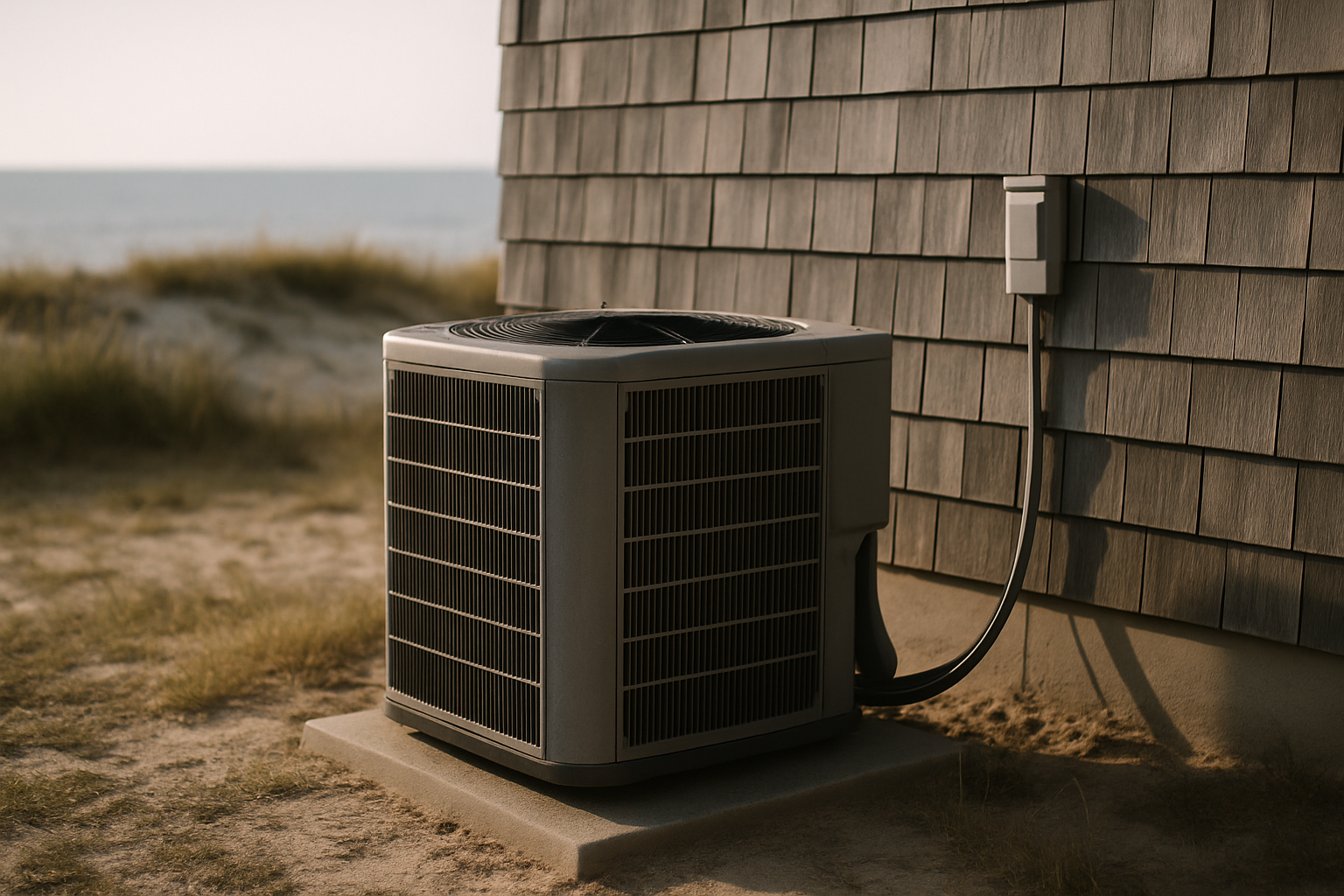
When to replace your AC at the NJ shore: how long coastal ACs actually last
Deciding when to replace your AC at the NJ shore means reading salt-adjusted age, not the data plate. Inland central air typically lasts 12–15 years; a condenser two blocks from the beach can age roughly twice as fast and may struggle to reach ten. Inspect fins, fasteners, contactors, and pans, then apply the 50% repair rule.
Deciding when to replace your AC at the NJ shore means reading salt-adjusted age, not the data plate. Inland central air typically lasts 12–15 years; a condenser two blocks from the beach can age roughly twice as fast and may struggle to reach ten. Inspect fins, fasteners, contactors, and pans, then apply the 50% repair rule.
How long does an AC last near the ocean in New Jersey?
Inland central air conditioning in Atlantic County typically lasts 12 to 15 years. That is the number most homeowners know, and it is accurate for inland conditions. The immediate shore is a different environment. Salt aerosol settles on the outdoor condenser coil and cabinet, and over time it corrodes fin material, rusts fasteners and base pans, and pits electrical contacts. Equipment that would last fifteen years in Hammonton might struggle to reach ten a block from the beach.
The useful way to read lifespan at the shore is not a single number but a set of exposure bands. Distance from salt water and how exposed the condenser is determine where your address falls.
| Location and exposure | Realistic lifespan | What drives it |
|---|---|---|
| Ten miles (16 km) inland, such as Egg Harbor Township | 12–15 years | Standard inland central AC baseline |
| Further inland, such as Hammonton | Around 15 years | Less airborne salt reaching the condenser |
| Barrier island a block or two from the beach, such as Longport | May struggle to reach ten without protection | Chloride settling on fins, coils, and contacts |
| Two blocks or less from the ocean | Ages roughly twice as fast as the same unit ten miles inland | A twelve-year-old oceanfront condenser is genuinely old |
Bayfront property counts the same way. Salt-laden air moves off the bay just as it moves off the ocean. On Longport, at the southern tip of Absecon Island, the Atlantic sits on one side and Great Egg Harbor Bay on the other, so the equipment gets exposure from both directions. Homes on the barrier islands — Atlantic City, Ventnor City, Margate City, Longport, and Brigantine — should plan from the shortest band unless the condenser is genuinely sheltered. Within each band, exposure still matters: a unit facing the water on an open deck ages faster than one tucked against the landward wall.
When should you replace your AC at the NJ shore?
Here is the reframe that matters. "How long does an AC last near the ocean?" is not a trivia question; it is a planning question. You are trying to find out whether your system is about to become an August emergency. The number that matters is not the calendar age stamped on the data plate. It is the salt-adjusted age.
A condenser two blocks from the beach can age roughly twice as fast as the identical unit ten miles inland in Egg Harbor Township. That means the decision clock starts earlier at the shore. Because a shore condenser ages at roughly double the inland rate, an eight- or nine-year-old oceanfront unit has already passed the equivalent of an inland system's full twelve-to-fifteen-year service life. A twelve-year-old oceanfront condenser is genuinely old.
The practical move is to start planning before the system forces the decision. The best replacement window in Atlantic County is spring — April through early June — or the early fall shoulder season. Schedules are more flexible, and island homeowners can have new equipment commissioned and proven before the summer rental season starts. Waiting until the first 95-degree week of July puts you in line with every other emergency in South Jersey.
The planning rule is simple: once a shore condenser passes its exposure-adjusted mid-life, get an inspection and a written replacement estimate even if the system still cools. You are buying time to choose instead of waiting to be chosen for.
How do you calculate your AC's salt-adjusted age?
You do not need software. You need three facts and one adjustment.
- Find the actual age of the outdoor condenser. The data plate usually carries a manufacture date; if it does not, the permit record or the previous owner's paperwork will.
- Place the home in an exposure band. Homes within two blocks of the ocean or bay sit in the severe band. Homes further back on the barrier islands sit in a moderate band. Homes ten miles or more inland sit in the standard band.
- Apply the salt multiplier. For a home two blocks or less from salt water, treat the condenser as aging roughly twice as fast as the same unit ten miles inland. In practical terms, multiply the actual age by two and compare the result against the inland baseline of twelve to fifteen years.
- Check the result against visible condition. The math tells you where the unit should be; the corrosion tells you where it actually is.
Here is the worked version. A ten-year-old condenser two blocks from the beach in Margate City has a salt-adjusted age of roughly twenty inland-equivalent years. That is well past the twelve-to-fifteen-year inland baseline. The same ten-year-old unit in Egg Harbor Township is simply a ten-year-old unit. Neither number is a death sentence by itself, but the first one places the system firmly in the replacement-planning zone and the second one does not.
The multiplier is a planning heuristic, not a warranty schedule. Twice the aging rate does not always translate into exactly half the years. A well-maintained unit can beat the math, and a neglected one can miss it. Use the salt-adjusted age to set expectations and timing, not to predict a failure date.
What does a shore AC nearing the end actually look like?
A coastal condenser nearing the end of its useful life shows it in two ways: the metal tells you, and the system's behavior tells you. You can read both without being a technician.
Walk around the outdoor unit first. Salt failure shows up on the outside:
- Aluminum fins turn chalky and crumble at the coil face.
- Fasteners rust through and cabinet screws seize.
- Contactors and disconnect terminals show pitting and corrosion.
- The base pan or drain pan rusts through.
Then watch how the system behaves during a normal hot week:
- You have needed repairs in back-to-back summers, or one repair quote already exceeds half the cost of a new system.
- Electric bills climb every summer even though your usage habits have not changed.
- The house cools unevenly, so upstairs bedrooms stay hot while the first floor is cold.
- The home feels humid and clammy even when the thermostat reads the right temperature.
- The outdoor unit is visibly corroded, loud at startup, or trips the breaker on hot afternoons.
- The system runs almost continuously on 90-degree days and still loses ground.
| Sign | What it means at the shore |
|---|---|
| Chalky, crumbling fins | The coil has lost heat-transfer surface, so the compressor works harder for the same cooling |
| Rusted fasteners and seized screws | Chloride has worked into the cabinet seams |
| Pitted contactor or disconnect | An electrical failure is waiting to happen under load |
| Rusted-through base or drain pan | The cabinet has been wet with salt spray for years |
| Back-to-back summer repairs | The system is failing in sequence, not once |
| Rising bills with unchanged habits | Efficiency is falling as corrosion loads the compressor |
| Runs continuously and loses ground | The system cannot meet the load on design days |
These are the same signals that matter inland, but at the shore they arrive on a shorter clock. The page on coastal HVAC corrosion protection at the NJ shore walks through which protection measures actually work. The signs above are the first read before you spend anything.
Which failures are worth repairing, and which mean replacement?
Start with age, then apply the 50 percent rule, then check the refrigerant.
Central air conditioners in Atlantic County typically last twelve to fifteen years, and less at the immediate shore where salt accelerates corrosion. A six-year-old system with a failed capacitor should obviously be repaired. A seventeen-year-old system with a failing compressor should almost never be. Between those poles, the 50 percent rule applies: when a repair estimate exceeds half the cost of a comparable new system, replacement is usually the smarter spend.
Refrigerant is the third test. If the system runs on R-22, any major refrigerant-circuit repair is hard to justify because the refrigerant itself is phased out and costly. A shore unit with a leaking R-22 coil is the clearest replacement case there is: the repair is expensive, the refrigerant is expensive, and the rest of the corroded system is queued behind it.
At the shore, add one more test that inland homeowners can skip: visible corrosion. A unit with chalky fins, rusted fasteners, pitted contacts, and a rusted-through pan is not failing once. It is failing in slow motion. Repairing one component on that unit buys a season, not a solution. The coastal case for replacement is stronger than the inland one at the same calendar age.
What should you specify when you replace an AC at the shore?
If you have reached the replacement decision, the short coastal lifespan is not a reason to accept it as normal. It is a reason to replace with coastal conditions in mind. Ask the contractor four things in writing:
- Is the outdoor unit a coastal or seacoast variant, and which failure points does it address: the fin pack, the cabinet, the fasteners, or the electrical compartment? A coastal-rated condenser installation for NJ shore homes should name those points rather than wave at "corrosion protection" generally.
- How is the system sized? The answer should be Manual J, not "same as the old one."
- Is the quote flat-rate and complete, and does it include the permit? New Jersey requires permits and inspections for air conditioning replacements, and the inspection is your independent check that the electrical, refrigerant, and mechanical work was done right.
- Who actually performs the work, and what commissioning steps are documented at the end?
On the islands, add one more question: what does the installer do differently for salt-air environments? A blank stare is disqualifying.
HappyVac describes its approach to the barrier islands as specifying coastal-rated AC and heat pump equipment for ocean-block and bay-block exposure, and planning around part-time occupancy rather than a fifty-two-week schedule. The company describes its team as a licensed and insured New Jersey contractor with NATE-certified, EPA-certified technicians, working same-day service over the Margate Bridge from the shop on Doughty Road in Pleasantville.
How do humidity and part-time occupancy change the timeline?
Salt is the headline, but Atlantic County's coastal air conditioners fight two other forces that shorten effective life: latent load (moisture removal) and vacancy.
Atlantic County runs from the Atlantic Ocean to the Pine Barrens, and the conditions an AC fights change dramatically along that line. At the shore, dew points sit in the 70s for weeks at a time, which means air conditioners spend as much energy wringing moisture out of the air as they do lowering the temperature. That constant dehumidification workload keeps compressors running longer cycles, keeps condensate drains flowing all season, and exposes every weak part in the system by the first real heat wave of July. A whole-house dehumidifier for NJ shore homes can shift some of that latent load off the air conditioner, which matters when you are trying to stretch a mid-age coastal system.
Part-time occupancy adds a different risk. A shore house that sits empty between visits has no one present to notice short-cycling, a failing condensate drain, or an outdoor unit that sounds wrong. Remote thermostat and humidity monitoring let an owner check the house from anywhere and catch a system that has stopped working before a small failure becomes a costly one. The same occupancy logic drives a separate set of winter decisions covered in the guide to second home HVAC freeze protection at the NJ shore.
Renovated and part-time shore homes also change the replacement shape. Many island homes have retrofitted or missing ductwork, and a ductless mini-split for a historic New Jersey home can be the right replacement form where running ducts would be a compromise. The lifespan math stays the same; the system form is a different answer to the same salt-air problem.
What does maintenance actually buy back near the ocean?
The phrase "if nothing is done about it" carries the whole maintenance question. A condenser that would last fifteen years in Hammonton might struggle to reach ten in Longport if nothing is done about it. Doing something starts with regular seasonal attention.
Seasonal maintenance gives a technician regular chances to inspect the outdoor unit, wash salt deposits off the coil before they etch the fin pack, and catch pitted contacts or rusted fasteners while the repair is still small. On a seasonal shore house, that inspection finds problems while they are minor instead of when the house is reopened for the summer.
Maintenance will not turn a standard inland condenser into a coastal-rated one. What it does is remove the avoidable early failures and help you see a replacement decision coming instead of meeting it on a hot afternoon. It is the difference between discovering a rusted contactor in March and discovering it as a no-cool call in August.
One caution: do not oversell the rinse. Washing salt off a coil is maintenance, not restoration. If the fins have already turned chalky and begun to crumble, the metal is gone and no amount of cleaning brings it back. Maintenance extends the life of a system that is still sound; it does not resurrect one that corrosion has already consumed.
How do you time the replacement to avoid the July rush?
The best time to replace an air conditioner in Atlantic County is spring — April through early June — or the early fall shoulder season. Schedules are more flexible, you are not living without cooling while you decide, and island homeowners can have new equipment commissioned and proven before the summer rental season starts.
Systems do not always fail conveniently. HappyVac offers same-day service and 24/7 emergency availability; if an AC dies mid-heat-wave, the practical move is to get temporary cooling options discussed and a replacement moving fast. But a homeowner who has already calculated the salt-adjusted age and read the corrosion signs will usually be replacing on a schedule, not an emergency.
The sequence that works: inspect in the spring, get the written estimate while the weather is mild, and schedule the replacement for the shoulder season. The salt-adjusted age tells you which year; the spring inspection tells you which month.
Frequently asked questions about NJ shore AC replacement
How long should an air conditioner last in Margate, Ventnor, or Longport?
Inland central air in Atlantic County typically lasts twelve to fifteen years. On the barrier islands, an exposed condenser may struggle to reach ten years if nothing is done about it. A condenser two blocks from the beach can age roughly twice as fast as the same unit ten miles inland, so a twelve-year-old oceanfront unit is genuinely old. Bayfront homes face the same salt exposure from the bay side.
Is a ten-year-old AC near the beach already at the end of its life?
Not automatically, but it is in the replacement-planning zone. Apply the salt multiplier: a ten-year-old condenser two blocks from salt water has a salt-adjusted age of roughly twenty inland-equivalent years, well past the twelve-to-fifteen-year inland baseline. Read the visible condition first: chalky fins, rusted fasteners, pitted contacts.
When should I replace my shore AC instead of repairing it?
Apply the 50 percent rule first: when a repair estimate exceeds half the cost of a comparable new system, replacement is usually the smarter spend. Then check the refrigerant. An R-22 system with a major refrigerant-circuit repair is hard to justify because the refrigerant is phased out and costly. At the shore, add visible corrosion: a unit already failing in slow motion usually makes replacement the honest call earlier than the same calendar age inland.
Does coastal-rated equipment actually last longer?
Coastal-rated equipment exists to address the specific salt failure points: the fin pack, the cabinet, the fasteners, and the electrical compartment. It does not make salt air harmless and it does not remove the need for maintenance, but it changes which parts fail first and how long they take to get there. Ask the installer to confirm which failure points a given model addresses before paying for the coastal upgrade.
Will seasonal maintenance extend my coastal AC's life?
Maintenance removes avoidable early failures: it washes salt deposits off the coil before they etch the fins and catches pitted contacts or rusted fasteners while the repair is still small. It will not turn a standard inland condenser into a coastal-rated one, and it cannot restore fins that have already crumbled. It buys back years on a sound system, not a consumed one.
What should part-time shore homeowners do differently?
A house that sits empty part of the year should not discover its HVAC problem on the first hot weekend. Remote thermostat and humidity monitoring let an owner check the house from anywhere, and seasonal maintenance still matters because salt damage accumulates whether or not the system runs. Plan replacement for the spring shoulder season so new equipment is commissioned before the summer rental season starts.