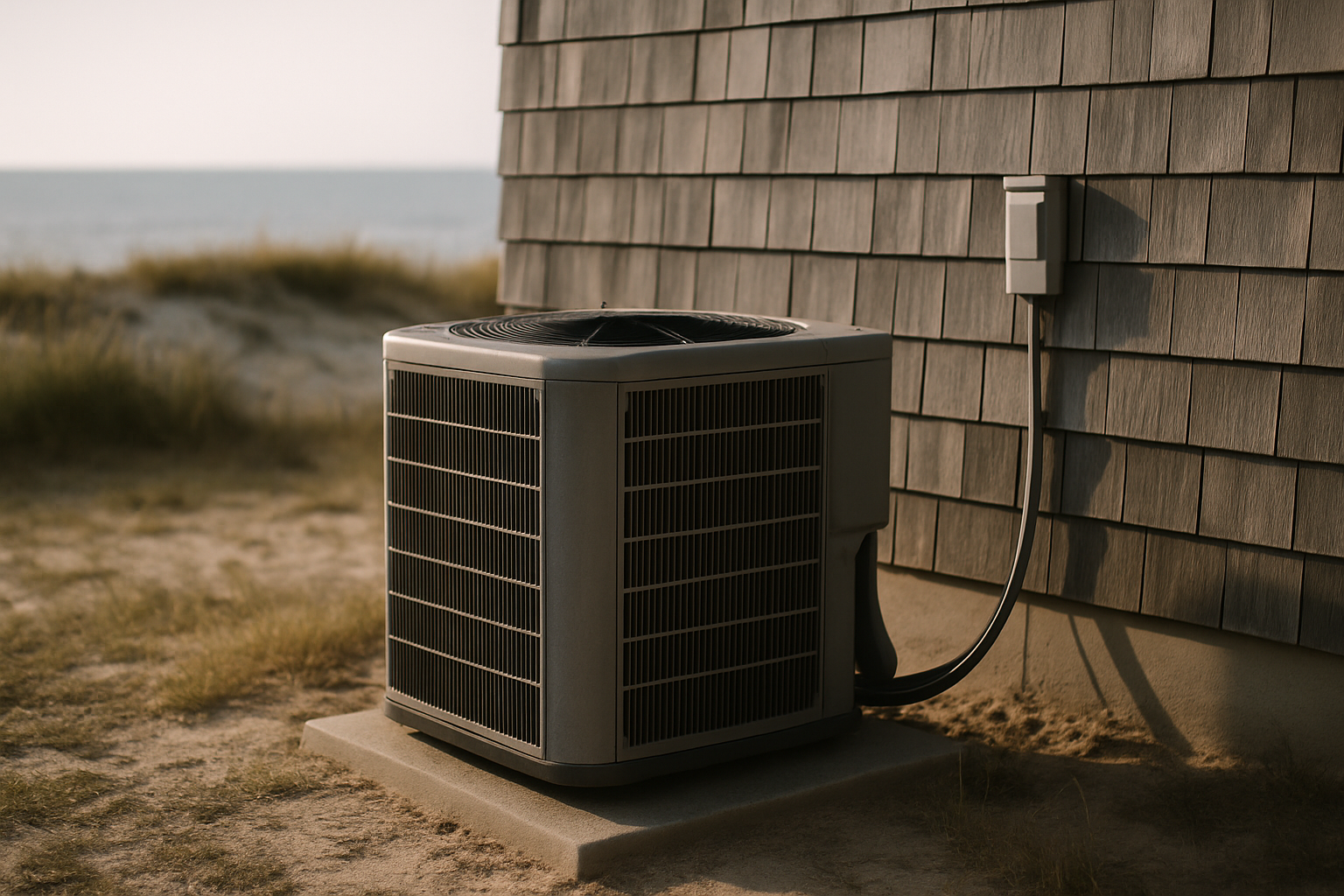
Salt Air AC Corrosion in Longport: Repair the Coil or Replace the Condenser?
In Longport, salt air air conditioner corrosion concentrates in the outdoor condenser. Fins, coils, cabinet hardware, contactors, and drain pans fail in a predictable order. Some damage is cosmetic; fin rot and refrigerant leaks are not. This guide separates repairable failures from compressor-life liabilities and shows when a coastal-rated replacement is the cheaper long-term decision.
In Longport, salt air air conditioner corrosion concentrates in the outdoor condenser. Fins, coils, cabinet hardware, contactors, and drain pans fail in a predictable order. Some damage is cosmetic; fin rot and refrigerant leaks are not. This guide separates repairable failures from compressor-life liabilities and shows when a coastal-rated replacement is the cheaper long-term decision.
The question is not whether salt air will attack the condenser. On Absecon Island, corrosion is a schedule. The real question is whether the damage in front of you is one repairable failure, or the first visible symptom of a unit that has already aged out early.
The repair-or-replace verdict for a salt-damaged condenser
Start with this rule: if one component has failed and the rest of the condenser is mechanically sound, repair is usually the right call. If corrosion has reached the fin pack, the coil, or multiple electrical components, replacement with a coastal-rated condenser usually wins.
That is not a matter of cosmetics. A condenser that has just failed one way from corrosion is often queuing up its next failure. The standard inland repair-versus-replace rules still apply in Longport, but with a coastal asterisk. Inland, central AC typically serves ten to fifteen years. Steps from salt water, the realistic window shrinks, and a twelve-year-old oceanfront condenser is genuinely old.
The 50% rule is the cleanest decision gate: when a repair exceeds half the cost of comparable new equipment, replacement usually wins. In Longport, that calculation has to be made against exposure-adjusted age, not calendar age alone.
| Decision factor | Repair the coil or component | Replace with a coastal-rated condenser |
|---|---|---|
| Failure pattern | One failed part; the rest of the unit is sound | Multiple corrosion failures or a major coil/refrigerant failure |
| Exposure-adjusted age | Low enough that the repair buys real remaining life | A twelve-year-old oceanfront condenser is genuinely old |
| Cost logic | Lower immediate outlay, but not automatically cheaper | Higher upfront cost; longer expected service life |
| Corrosion state | Damage is isolated; compressor and cabinet are still sound | Fin rot is widespread, the cabinet is rusting through, or contacts are pitted throughout |
| Risk you carry | The next corroded component may fail soon | Upfront cost and installation work |
| Best decision | Burned contactor, failed fan motor, early coil damage | Refrigerant leak in a corroded coil, or repeated seasonal failures |
The table is the decision in one view. The rest of this page explains how to read the condenser in front of you.
Which condenser components corrode first in Longport?
Salt aerosol does not attack every part of an air conditioner evenly. It concentrates in the outdoor condenser, and the damage follows a recognizable order.
Fins. Salt deposits settle on the aluminum fins that shed heat from the coil. Fins turn chalky and crumble. As the fin surface degrades, the condenser transfers heat poorly. The compressor then works harder, electric bills rise, and compressor life shortens. Fin damage is often the first visible sign that a Longport unit is living in coastal air.
Coils. Corroded coils are the serious version of fin damage. When corrosion reaches the coil tubing, it can create a refrigerant leak or reduce heat transfer enough to force the compressor into a long, hot decline. A coil that has lost its fin surface and begun to pit is no longer just ugly; it is changing how the whole system operates.
Cabinet hardware. Salt works into sheet-metal seams. Screws seize, fasteners rust through, and base pans rust. This matters twice: a rusted cabinet lets more salt and moisture reach the electrical compartment, and seized hardware makes future service slower and more expensive.
Contactors and electrical terminals. Salt aerosol pits contactor points and disconnect terminals until they fail under load. The symptom is usually an outdoor unit that hums, clicks, or will not start at all. A burned contactor is a real repair, but it is also a warning that salt has entered the electrical compartment.
Drain pans and base pans. On shore equipment, drain pans rust through. A rusted base pan may not stop the unit immediately, but it is structural evidence that the cabinet has been living in salt air long enough to be questioned.
The pattern is the point. A failed contactor by itself is a component repair. A failed contactor sitting on top of crumbling fins and a rusted base pan is a replacement conversation.
Is it cosmetic corrosion or a performance-killing problem?
Longport homeowners often see a chalky, white-green residue on the condenser and wonder whether it is a real failure. The honest answer is that surface oxidation can be cosmetic, but fin rot and refrigerant leaks are not.
Cosmetic corrosion is usually surface rust, faded paint, or light white oxidation on exposed edges. It looks bad and it should be cleaned and watched, but it does not by itself mean the system has stopped rejecting heat. A technician can confirm that the coil is still intact and the charge is still correct.
Fin rot is the transition from appearance to performance. Fins turn chalky and crumble across a meaningful portion of the coil. Once enough fin surface is gone, the condenser cannot shed heat efficiently, and the compressor runs hotter and longer. Fin rot does not always mean the refrigerant circuit has opened, but it does mean the unit is losing capacity and efficiency.
A refrigerant leak is a sealed-system failure, not a surface problem. It may present as warm or room-temperature air from the vents, ice forming on the refrigerant lines or indoor coil, short cycling, or an empty charge. A corroded coil can leak refrigerant, but the leak itself cannot be confirmed by looking at the outside of the unit. It takes gauges, leak detection, and a technician who is not guessing.
The practical separation is this: if the damage is on the surface and the system is holding charge and meeting temperature, you may have time. If the fins are crumbling across the coil or the system is losing refrigerant, you are past the cosmetic stage and into the repair-or-replace decision.
How do bayfront, oceanfront, and inland Longport exposures differ?
Longport is small, but the exposure gradient is real. The same model condenser will age differently depending on which side of the borough it sits on.
Oceanfront. This is the harshest residential environment in New Jersey. Salt aerosol settles directly on the coil and cabinet, and wind-driven spray carries it deeper into the unit. HappyVac notes that a condenser two blocks from the beach commonly ages twice as fast as the identical unit ten miles inland in Egg Harbor Township. Oceanfront units are the ones where an exposure-adjusted age calculation matters most.
Bayfront. Bayfront Longport homes get brackish air and the temperature swings of the bay side. The spray is not always as direct as on the oceanfront, but the moisture is persistent, and salt still finds seams, fasteners, and electrical contacts. Bayfront equipment should be treated as coastal equipment, not inland equipment that happens to be near water.
Inland Longport. A few blocks west, exposure drops, but it does not go to zero. Longport is a barrier island, and no address in the borough is far from salt water. Inland Longport units last longer than oceanfront units, but they still need corrosion-aware inspection and maintenance.
The exposure zone changes the inspection schedule and the replacement threshold, not the basic decision rule. An oceanfront unit that would be "middle-aged" inland may already be near the end of its service life.
When should Longport homeowners inspect the condenser?
In Longport, inspection timing should follow the weather, not just the calendar. There are two checks that catch most salt-air failures before they become August emergencies.
The pre-season spring check. Before the first sustained heat, inspect the condenser fins, coil, cabinet hardware, and contactor. This is the moment to catch early fin rot, a pitted contactor, or a rusting base pan before the system is asked to run flat-out. A pre-season repair is usually cheaper and calmer than a same-week failure during the first heat wave.
The post-storm check. After a nor'easter or any coastal storm that drives salt spray, sand, and debris onto the equipment, check the condenser again. Salt film that sits on fins and seams becomes the next round of corrosion. Storm debris can also block airflow, which raises head pressure and shortens compressor life. A post-storm inspection is especially important for seasonal homes that may sit closed for weeks after a storm.
For seasonal owners and property managers, the sensible sequence is a spring check before summer occupancy and a post-storm check after any significant coastal event. The same logic applies to year-round homes, but with the added value of catching failures before a 24/7 emergency call becomes necessary.
What can coil replacement and contactor replacement actually fix?
Repair is not one thing. The component that failed determines whether a repair is a good bet or a bridge to the next failure.
Contactor replacement. A burned or pitted contactor is a lower-cost component repair. It fixes an outdoor unit that hums, clicks, or will not start. If the rest of the condenser is sound, this is exactly the kind of failure worth repairing.
Condenser fan motor replacement. A failed fan motor is also a repairable component. The repair restores airflow across the coil and prevents the compressor from overheating. Like the contactor, it is a good repair when the unit is otherwise healthy.
Coil replacement. A corroded or leaking coil can sometimes be replaced without replacing the entire condenser. This is a major repair, not a minor one. It makes sense when the compressor is still sound, the cabinet is intact, and the exposure-adjusted age of the unit justifies the investment. It makes less sense when the coil failure has already forced the compressor to run hot for several seasons, or when the cabinet and electrical compartment show the same corrosion.
What repair cannot fix. A component repair cannot restore a fin pack that has rotted across the coil. It cannot undo years of high head pressure on a compressor that has been working against a corroded coil. It cannot rebuild a cabinet that has rusted through. Those conditions are not single failures; they are the accumulated cost of salt air.
The cost framing matters here. A contactor is a lower-cost repair. A coil replacement is a major repair whose cost depends on warranty coverage, refrigerant type, access, and whether the compressor is still viable. HappyVac quotes flat-rate written pricing before any work starts, so the repair number and the replacement number are both fixed before you choose.
When does a coastal-rated replacement become the cheaper long-term call?
Replacement is not just about the failed part. It is about the unit's remaining exposure-adjusted life.
A corroded coil transfers heat poorly, which forces the compressor to work harder, which raises electric bills and shortens compressor life. By the time a Longport condenser shows a refrigerant leak in a corroded coil, repeated seasonal failures, or widespread fin rot, the real question is whether the compressor has already been paying for the corrosion.
The 50% rule is the most useful threshold. When a repair exceeds half the cost of comparable new equipment, replacement usually wins, because a corroded system that just failed one way is queuing up its next failure. On the island, that rule applies earlier than it would inland.
This is where a coastal-rated condenser changes the math. Coastal-rated is a real specification, not a marketing sticker. On models built for exposed shore addresses, the outdoor coil carries a factory-applied protective coating across the fin pack, the cabinet uses heavier corrosion-resistant finishing, fasteners are upgraded to stainless or coated hardware, and the electrical compartment is sealed more thoroughly against airborne moisture. Carrier, Trane, Daikin, Mitsubishi, and several other manufacturers publish coastal or seacoast variants of popular product lines.
The upcharge is real, and so is the extra service life. For a Longport owner replacing a corroded condenser, the right comparison is not just the lowest installed price; it is the cost per year of a unit specified for the shore. A standard replacement may be cheaper today and begin corroding on the same schedule as the unit it replaced. If you are already replacing because of salt, the coastal-rated condenser installation for NJ shore homes decision belongs in the estimate rather than after the fact.
The efficiency and compressor-life argument is the strongest one for replacement. A new coastal-rated condenser starts with a clean coil, a protected fin pack, and a compressor that is not compensating for corrosion. That is a different liability profile than a repaired unit with a new contactor sitting inside an old, salt-weakened cabinet.
How does HappyVac's flat-rate written quote work on a repair-or-replace call?
The repair-or-replace decision is hard enough without open-ended pricing. HappyVac's process is built around a flat-rate, written quote before work begins.
On a salt-damaged condenser, that means the technician diagnoses the failure, separates cosmetic corrosion from performance-killing damage, and then prices the repair option and the replacement option as fixed numbers. You are not deciding between an hourly repair estimate and a vague replacement range. You are comparing two written prices against the 50% rule and the unit's exposure-adjusted age.
The quote is the point where the coastal conversation happens. If replacement is in play, the estimate should show the difference between a standard condenser and a coastal-rated condenser specified for a Longport exposure. If repair is the right call, the written price covers the component, labor, and any refrigerant or access work required.
HappyVac serves Longport and the rest of Absecon Island with same-day service across the island, 24/7 emergency response for year-round residents and property managers, and licensed, insured NJ technicians with NATE- and EPA-certified credentials. The flat-rate quote applies whether the answer is a contactor, a coil, or a full coastal-rated replacement.
What repair and replacement have in common
The two paths are different, but they start in the same place.
Both require a diagnosis that separates surface rust from fin rot and a refrigerant leak. Both should be judged against exposure-adjusted age, not the age a condenser would reach inland. Both benefit from corrosion-aware maintenance: a repaired unit still needs pre-season and post-storm checks, and a new coastal-rated unit still needs the same discipline to protect its longer service life. Both should be quoted flat-rate and in writing before work starts.
The decision is not "repair is always cheaper" or "replacement is always better." It is a comparison of the next failure risk against the cost of resetting the corrosion clock.
The cost of guessing wrong
Guessing wrong in either direction has a price.
If you replace a repairable unit too early, you spend a full replacement budget on a condenser that still had service life left. That is the smaller error in Longport, but it is still money that did not need to be spent.
If you repair a condemned unit, you buy a short window. A new contactor does not restore a rotted fin pack. A coil replacement does not undo compressor wear from years of high head pressure. The next failure arrives, often in the middle of the cooling season, and you pay twice: once for the repair and again for the replacement you were postponing.
The 50% rule exists to prevent the second error. Exposure-adjusted age exists to prevent the first. Together, they turn a salt-damaged condenser from an emotional decision into a calculation.
For more on how ocean exposure shortens equipment life, see the guide to how long an AC lasts near the ocean in New Jersey. For the maintenance that slows the corrosion schedule, see coastal HVAC corrosion protection at the NJ Shore.
Frequently asked questions about salt air AC corrosion in Longport
Does salt air really shorten AC lifespan in Longport?
Yes. Salt aerosol settles on the outdoor coil and cabinet, corroding fin material, rusting fasteners and base pans, and pitting electrical contacts. HappyVac notes it is common for a condenser two blocks from the beach to age twice as fast as the same unit ten miles inland. Inland central AC may serve ten to fifteen years; steps from salt water, the realistic window shrinks.
Can a corroded condenser coil be repaired?
In some cases, yes. A failed coil can be replaced without replacing the whole condenser if the compressor and cabinet are still sound. The call depends on exposure-adjusted age and whether the coil has begun leaking refrigerant. When a corroded coil has already forced the compressor to work harder, or the repair exceeds half the cost of comparable new equipment, replacement usually wins.
How do I tell fin rot from a refrigerant leak?
Fin rot is visible: fins turn chalky, crumble, and lose their ability to shed heat, but the system may still hold refrigerant. A refrigerant leak is a sealed-system failure that shows up as weak cooling, ice on lines or the indoor coil, or an empty charge. Only a technician with gauges and leak detection can confirm a leak; do not assume looks alone.
Is a coastal-rated condenser worth the extra cost in Longport?
Yes for most exposed Longport addresses. On coastal-rated models, the coil carries a factory-applied protective coating across the fin pack, the cabinet uses heavier corrosion-resistant finishing, fasteners are upgraded, and the electrical compartment is sealed more thoroughly. The upcharge is real, and so is the extra service life.
When should I inspect my Longport condenser?
Twice at minimum: before cooling season, before the first sustained heat, and again after any nor'easter or coastal storm that drives salt spray and sand onto the equipment. Pre-season inspection catches early fin and contactor damage before demand rises; post-storm inspection catches fresh salt film and debris before it bakes on.
What does AC repair cost in Longport?
There is no flat statewide number. A contactor is a lower-cost component repair; a coil replacement is a major repair whose price depends on warranty coverage, refrigerant, and access. HappyVac uses flat-rate written pricing quoted before work begins, so the repair and replacement options are compared as fixed numbers rather than an open-ended hourly estimate.